
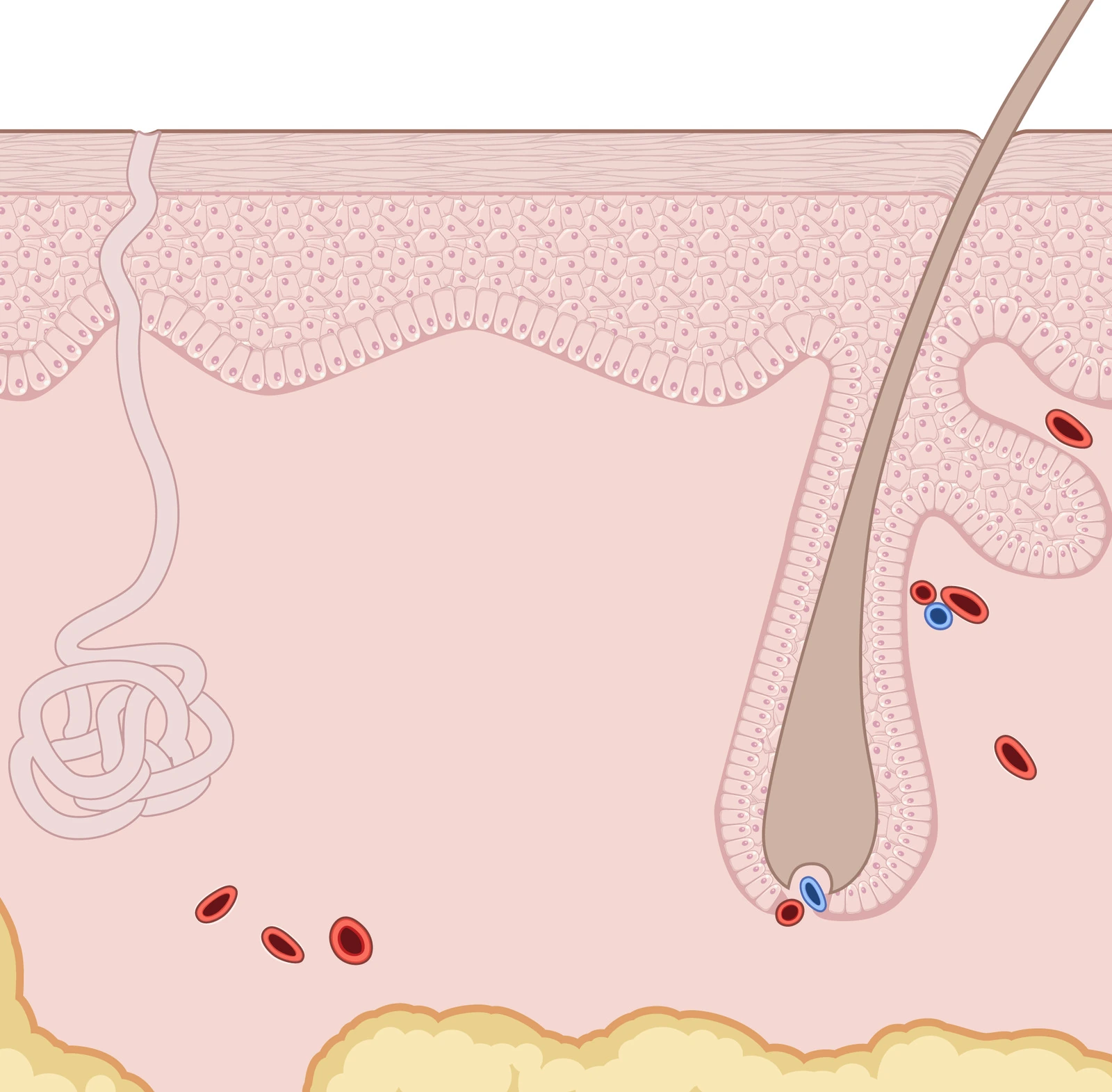
Skin is the body's largest organ, covering about 1.5 to 2 square metres in an adult. It keeps water in and germs out, senses touch, heat and pain, helps control body temperature and carries its own immune cells.
Ikigai Daily
The story behind the card
Skin has two main layers. The thin outer epidermis is constantly renewed: new cells form at its base and, over roughly a month or two, rise to the surface, harden and die, forming a waterproof shield before they flake away. Beneath it, the dermis holds blood vessels, sweat glands, hair roots and nerve endings. Sweat cools the body as it evaporates, and vessels near the surface widen to shed heat or narrow to keep it in. Specialised nerve endings respond to light touch, vibration, pressure, heat, cold and harmful stimuli. The epidermis also contains Langerhans cells, immune cells that pick up pieces of invading germs and carry them to the lymph nodes, the immune system's small filtering stations, to raise the alarm. Sunlight on the skin also starts the body's production of vitamin D.
Türkçe oku
Deri, vücudun en büyük organıdır; bir yetişkinde yaklaşık 1,5 ile 2 metrekarelik bir alanı kaplar. Suyu içeride, mikropları dışarıda tutar; dokunuşu, sıcağı ve acıyı hisseder, vücut ısısının ayarlanmasına yardım eder. Kendine ait bağışıklık hücreleri de vardır.
Derinin iki ana katmanı vardır. En dıştaki ince katman olan epidermis sürekli yenilenir: Yeni hücreler bu katmanın tabanında oluşur, bir iki ay içinde yüzeye çıkar, sertleşip ölür ve dökülene kadar su geçirmez bir kalkan görevi görür. Altındaki dermiste kan damarları, ter bezleri, kıl kökleri ve sinir uçları bulunur. Ter buharlaşırken vücudu serinletir; deri yüzeyine yakın damarlar ısı atmak için genişler, ısıyı korumak için daralır. Özelleşmiş sinir uçları hafif dokunuşa, titreşime, basınca, sıcağa, soğuğa ve zarar verebilecek uyaranlara tepki verir. Epidermiste Langerhans hücreleri adlı bağışıklık hücreleri de bulunur: İçeri sızan mikroplardan parçalar yakalar ve bunları bağışıklık sisteminin küçük süzgeç istasyonları olan lenf düğümlerine taşıyarak alarm verirler. Deri güneş ışığı aldığında vücut D vitamini üretmeye de başlar.
Sources and further reading
Image details
A simplified cross-section of skin, showing tissue layers, a hair follicle and a sweat gland.
Ryan Kissinger, NIAID Visual & Medical Arts (NIH BioArt), 2026. Public domain.
Cropped.