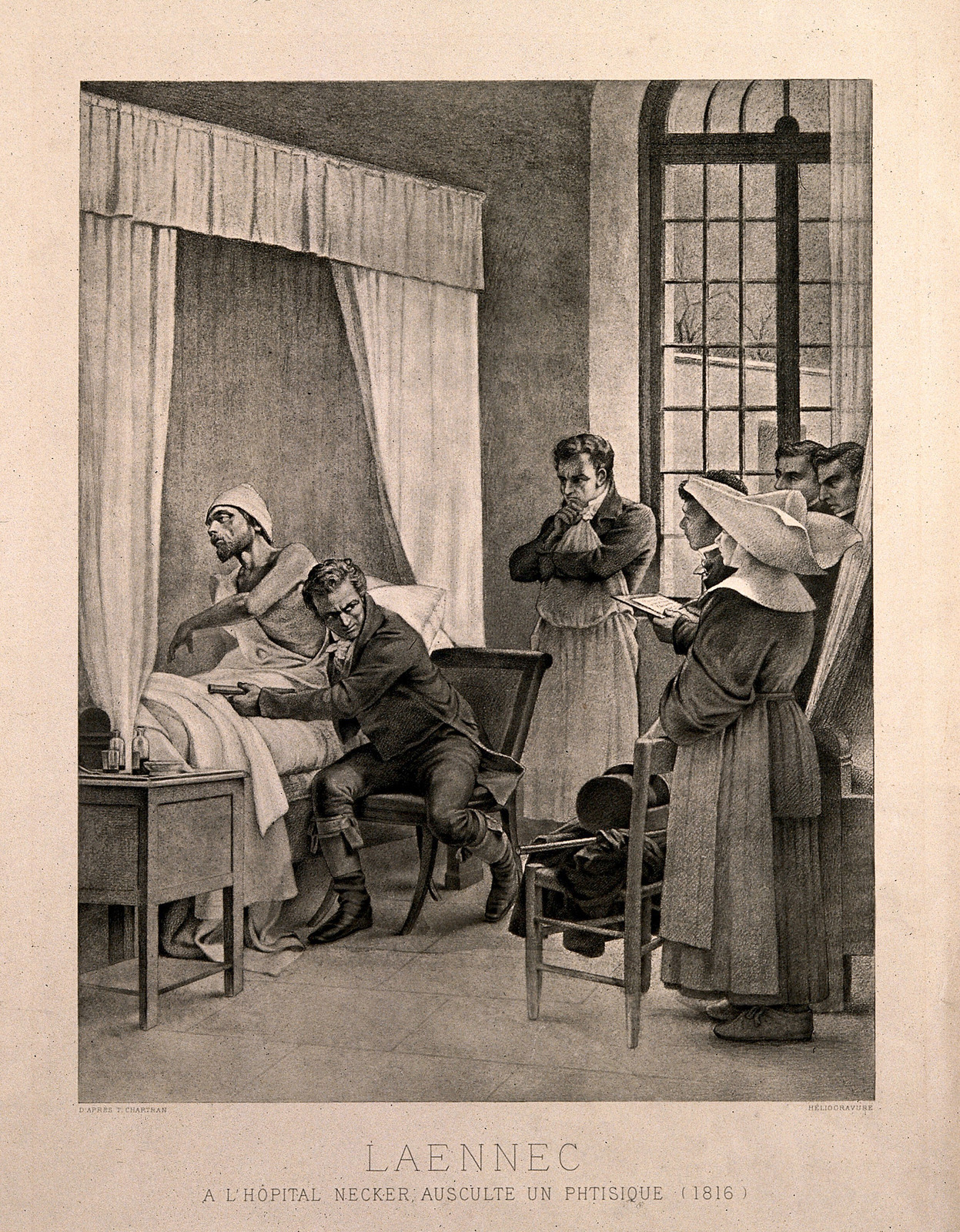
The stethoscope began in 1816 with a roll of paper. French physician René Laennec, examining a young woman, thought it unsuitable to press his ear to her chest, so he rolled paper into a tube and found that heart sounds travelled through it clearly. He later made a wooden version and called the method mediate auscultation, meaning listening through an instrument.
René Laennec, Paris, 1816
The story behind the card
Laennec called his method 'mediate auscultation' because the instrument stood between his ear and the patient, unlike direct auscultation, in which a doctor listened with an ear right on the chest. He soon replaced the rolled paper with a hollow wooden cylinder about 25 cm long, a shape doctors kept using for decades. The word stethoscope comes from the Greek stethos, chest, and skopein, to examine. Laennec spent years comparing the sounds he heard in living patients with what autopsies later showed, laying the foundations of a diagnostic method still used today. He died of tuberculosis in 1826, aged 45; his nephew is said to have diagnosed the disease with Laennec's own stethoscope.
Türkçe oku
Stetoskopun hikâyesi 1816'da bir kâğıt rulosuyla başladı. Fransız hekim René Laennec genç bir kadını muayene ederken kulağını doğrudan göğsüne dayamayı uygun bulmadı; bir kâğıdı sıkıca sarıp boru yaptı ve kalp seslerinin bu borudan çok net geldiğini fark etti. Sonra tahtadan bir benzerini yaptı ve yöntemine “dolaylı dinleme” adını verdi.
Laennec yöntemine “dolaylı dinleme” adını verdi, çünkü kulağıyla hasta arasına bir alet giriyordu; o zamana kadar hekimler kulaklarını doğrudan göğse dayayarak dinlerdi. Kâğıt ruloyu kısa sürede yaklaşık 25 santimetre uzunluğunda, içi boş tahta bir silindirle değiştirdi; hekimler bu biçimi onlarca yıl kullandı. “Stetoskop” sözcüğü Yunanca “stethos” (göğüs) ve “skopein” (incelemek) sözcüklerinden gelir. Laennec yıllarca, hastalarında duyduğu sesleri sonradan yapılan otopsilerde bulunanlarla karşılaştırdı ve bugün hâlâ kullanılan bu tanı yönteminin temelini attı. 1826'da, 45 yaşında veremden öldü; hastalığını yeğeninin, Laennec'in kendi stetoskopuyla teşhis ettiği anlatılır.
Sources and further reading
Image details
Later depiction of Laennec examining a tuberculosis patient at Necker Hospital, Paris; heliogravure after Théobald Chartran's Sorbonne mural.
Heliogravure after Théobald Chartran (d. 1907), mural at the Sorbonne, Paris. Wellcome Collection (545580i). Public domain.