Active sonar, which finds things underwater by sending out sound and listening for the echo, began in the First World War. In 1915 Constantin Chilowsky, a Russian engineer in France, proposed hunting submarines this way, and the physicist Paul Langevin made it work with quartz crystals that could both send and receive the sound.
Constantin Chilowsky; Paul Langevin and collaborators (1915–1918)
The story behind the card
Sound travels much farther than light underwater, and the time its echo takes to return gives the distance. Langevin and Chilowsky began in 1915 with electrostatic transducers, devices that turn electrical signals into sound and back, then switched to quartz in 1917. Quartz works because of the piezoelectric effect, which the Curie brothers had discovered in 1880; Langevin had been a student of Pierre Curie. In Britain, the Canadian physicist Robert Boyle and A. B. Wood built a quartz prototype in 1917, called ASDIC. Neither system was ready before the war ended. The Admiralty later claimed ASDIC stood for 'Allied Submarine Detection Investigation Committee', but no such committee has been found. The American name SONAR, from 'sound navigation and ranging', came in the 1930s.
Türkçe oku
Aktif sonar suya ses gönderir ve dönen yankıdan su altındaki cisimleri bulur. Bu yöntem Birinci Dünya Savaşı'nda doğdu: Fransa'da yaşayan Rus mühendis Constantin Chilowsky 1915'te denizaltıları bu yolla aramayı önerdi, fizikçi Paul Langevin de sesi hem gönderip hem alabilen kuvars kristalleriyle fikri çalışır hâle getirdi.
Su altında ses ışıktan çok daha uzağa ulaşır; yankının dönme süresi de hedefin uzaklığını verir. Langevin ile Chilowsky 1915'te elektrik sinyalini sese, sesi de elektrik sinyaline çeviren elektrostatik dönüştürücülerle işe başladılar, 1917'de kuvarsa geçtiler. Kuvarsın bu işe yaraması, Curie kardeşlerin 1880'de keşfettiği piezoelektrik etki sayesindedir; Langevin de Pierre Curie'nin öğrencisiydi. İngiltere'de Kanadalı fizikçi Robert Boyle ile A. B. Wood, 1917'de ASDIC adını verdikleri kuvarslı bir deneme cihazı yaptı. İki sistem de savaş bitmeden kullanıma hazır olamadı. İngiliz Deniz Kuvvetleri sonradan ASDIC'in “Müttefik Denizaltı Tespit Araştırma Komitesi” anlamına geldiğini söyledi, ama böyle bir komitenin varlığına dair hiçbir kayıt bulunamadı. Amerikalıların kullandığı SONAR adı ise 1930'larda, İngilizce “ses ile yön bulma ve mesafe ölçme” sözlerinin baş harflerinden türetildi.
Sources and further reading
Image details
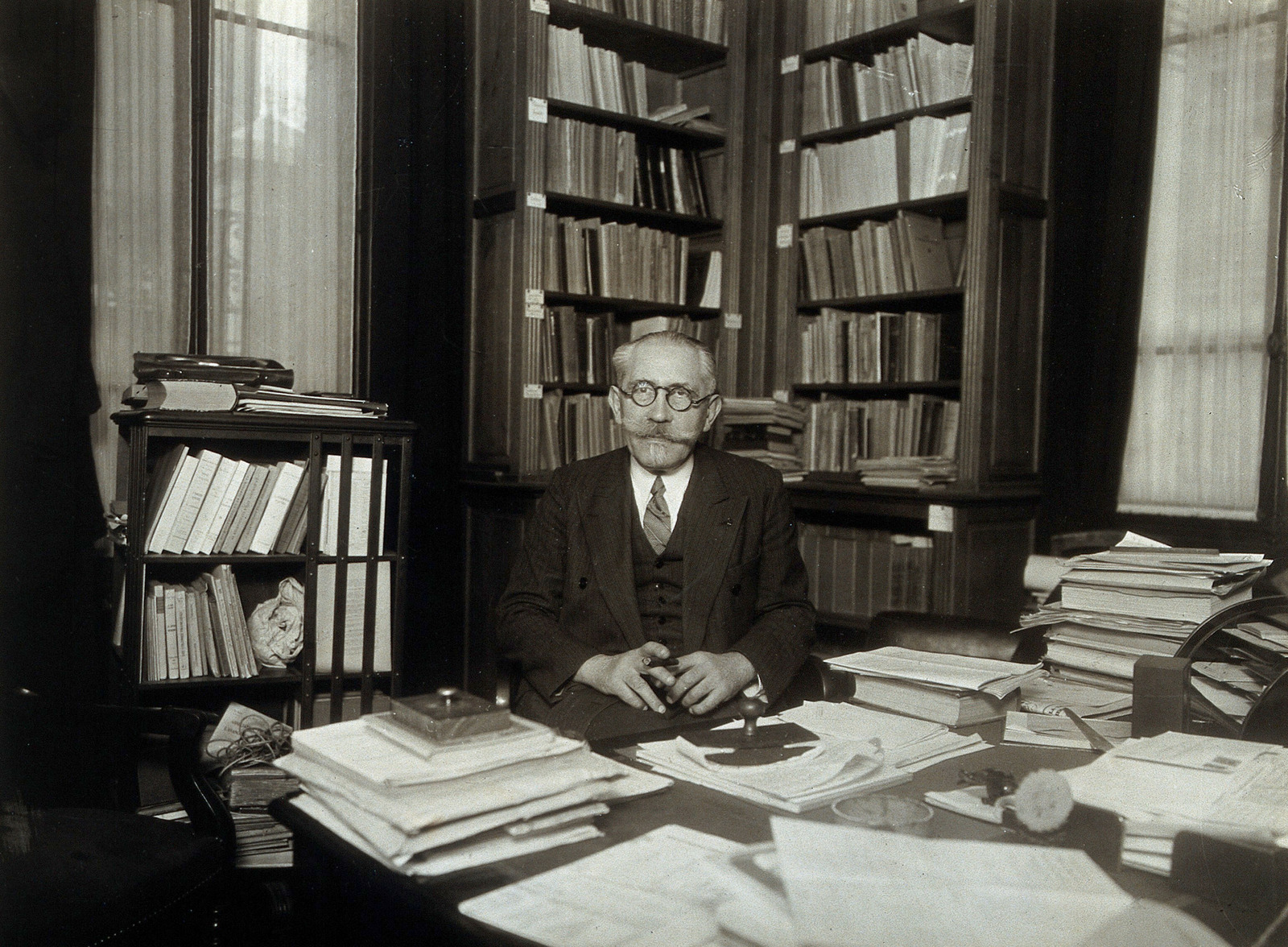
Paul Langevin at his desk, photographed by Henri Manuel.
Henri Manuel, undated. Wellcome Collection. Public domain.