
People and the past

History

Discover the people, inventions and events behind the world we live in.

Subject collectionPage 6Context and sources

Related subjects

Browse this subject and connected topics.

Keep reading below, or choose a related topic to explore something different.

DriveReading mode
StillnessReading mode
WonderReading mode
DriveHistory

Harland Sanders was in his early sixties when the first Kentucky Fried Chicken franchise opened, in Utah in 1952. At 65, after a new highway took the traffic away from his roadside café in Corbin, Kentucky, he sold it and took to the road, selling his recipe to other restaurants.

Sanders had been frying chicken for travellers at his café and motel on a busy road in Corbin since the 1930s. He was never an army officer: in 1935 the governor of Kentucky made him an honorary Kentucky Colonel. His first franchisee was Pete Harman, who ran a large restaurant in South Salt Lake, and it was a sign painter hired by Harman who came up with the name Kentucky Fried Chicken. Franchisees paid Sanders four cents for every chicken sold. When the café closed, he lived on his savings and a $105 monthly Social Security pension while he drove from town to town. By 1963 there were more than 600 KFC restaurants. The next year, aged 73, he sold the company for $2 million and stayed on as its white-suited public face. A popular story says he was turned down 1,009 times; no reliable record confirms that number.
WonderHistory

On 17 December 1903, near Kitty Hawk, North Carolina, Orville Wright flew 37 m in 12 seconds. Others had engines too; what the Wright brothers had solved was control. The pilot could tilt the wings, raise or lower the nose and turn, keeping the aircraft balanced in the air.

Most experimenters of the time concentrated on more powerful engines and thought of steering like a ship's rudder. The Wrights, who built bicycles in Dayton, Ohio, saw that a flying machine had to be balanced like a bicycle and lean into turns like a bird. Wilbur noticed that birds change the angle of their wingtips to roll, and the brothers copied this with wing-warping: cables twisted the ends of the wings to tip the aircraft left or right. With a front elevator for climbing and diving and a movable rudder for turning, the pilot could control all three directions of movement, known as three-axis control. They tested wing shapes in a home-made wind tunnel in 1901 and learned on gliders before adding an engine. Four flights were made that day; the longest, by Wilbur, lasted 59 seconds and covered 260 m. Aeroplanes still use three-axis control today.

WonderHistory

The Rosetta Stone carries the same decree three times: in hieroglyphs, in Demotic, an everyday Egyptian script, and in ancient Greek. Scholars could still read Greek, so they could compare it with the Egyptian versions line by line. In 1822 the French scholar Jean-François Champollion used it to crack the hieroglyphic script.

Hieroglyphs had been unreadable for more than 1,400 years: the last known inscription was carved in AD 394, and later scholars wrongly assumed that every sign stood for an idea. The breakthrough came through names. Royal names are written inside oval frames called cartouches, and from 1814 the English scientist Thomas Young matched the cartouche on the stone with the Greek name Ptolemy and worked out some of its sounds. Champollion knew Coptic, the last stage of the Egyptian language, still used in the Coptic Church. In September 1822, in a letter to the secretary of the French Academy of Inscriptions, he announced that many hieroglyphs stood for sounds, and by 1824 he had shown that the script combines signs for sounds with signs for meanings. Over the following decades, texts from more than 3,000 years of Egyptian history became readable again.

WonderHistory

Johannes Gutenberg's Bible, printed in Mainz in the 1450s, was the first major European book made with movable metal type. Yet it was made to look like a luxury manuscript: its letters imitate scribes' handwriting, colours were added by hand, and about a quarter of the copies were printed on vellum, fine calfskin.

Scholars think Gutenberg printed between 160 and 185 copies, about three-quarters on paper and the rest on vellum. Each page has 42 lines, which is why it is also called the 42-line Bible. To imitate handwriting, his workshop needed 290 different characters, including the joined letter pairs that scribes used. Red headings, known as rubrics, were printed at first but soon left blank for a scribe to add by hand, and buyers had artists paint decorated initials and borders, so no two copies look alike. In March 1455 Enea Silvio Piccolomini, the future Pope Pius II, wrote that he had seen pages on show in Frankfurt. Of the 49 copies that survive in substantial part, a vellum one is on display at the Library of Congress in Washington.

WonderHistory

In 1990 Tim Berners-Lee ran the first website from a NeXT computer in his office at CERN, near Geneva. A handwritten sticker on it read: ‘This machine is a server. DO NOT POWER IT DOWN!!’ At first it was the only web server, so switching it off would have taken the web offline.

NeXT was the computer company Steve Jobs founded in 1985 after leaving Apple. On this machine Berners-Lee wrote the building blocks the web still uses: HTML, the language web pages are written in; HTTP, the rules a browser and a server use to talk to each other; and the first browser, called WorldWideWeb, which could also edit pages. The first website, info.cern.ch, went online on 20 December 1990 and explained what the web was and how to set up a server. The web opened to the wider internet in August 1991, and on 30 April 1993 CERN made the software free for anyone to use. By then the web had spread far beyond CERN: the first web server outside Europe had gone online at the Stanford Linear Accelerator Center in California in December 1991.

WonderScience

Only 65 years separate the Wright brothers' first powered flight, 37 m (120 ft) in 12 seconds on 17 December 1903, from the Moon landing of July 1969. Neil Armstrong carried a piece of the Wright Flyer's wing fabric and a sliver of its propeller wood with him to the Moon.

Aviation moved fast between those dates. In 1919 John Alcock and Arthur Brown made the first non-stop flight across the Atlantic. In 1947 Chuck Yeager flew faster than sound in the rocket-powered Bell X-1. In 1957 the Soviet Union launched Sputnik, the first artificial satellite, and in 1961 Yuri Gagarin became the first person in space. Orville Wright, who piloted that first flight, lived until 1948. The Flyer itself spent 20 years at the Science Museum in London: the Smithsonian Institution had credited its former head, Samuel Langley, with the first machine capable of flight, and Orville sent the Flyer abroad in protest. It returned to the United States in 1948 and is on display at the National Air and Space Museum in Washington. In 2021 another scrap of its wing fabric flew on Mars, fixed to NASA's Ingenuity helicopter.

WonderLanguage

The sandwich takes its name from John Montagu, 4th Earl of Sandwich (1718–1792). The popular story says he asked for meat between slices of bread so he could eat without leaving the card table; his biographer thinks he more likely ate it at his desk.

The gambling version comes from the French writer Pierre-Jean Grosley, who visited London in 1765 and described a minister who stayed at the gaming table for 24 hours, living on beef between slices of toast. His book appeared in French in 1770 and in English in 1772. The historian N. A. M. Rodger, Sandwich's biographer, points out that as First Lord of the Admiralty, the minister in charge of the Royal Navy, Sandwich was a hard-working man who was more likely eating at his desk. Putting food between bread was nothing new; his title simply gave it a name. Captain James Cook, whose Pacific voyages Sandwich supported, also named the Sandwich Islands, today Hawaii, in his honour.

WonderLanguage

September, October, November and December are named from the Latin numbers septem, octo, novem and decem: seven, eight, nine and ten. They are now the ninth to twelfth months because the Roman year once began in March.

According to Roman tradition, the city's first calendar, credited to its legendary founder Romulus, had only ten months: the year began with March in spring and ended with December, and the winter weeks were left out of the count. A later king, Numa Pompilius, is said to have added January and February. From 153 BC the year of Rome's chief magistrates, the consuls, began on 1 January, but the old month names stayed. Two more months once had number names: Quintilis, 'fifth', was renamed July after Julius Caesar in 44 BC, and Sextilis, 'sixth', became August in honour of the emperor Augustus in 8 BC.

WonderLanguage

In 1887 L. L. Zamenhof, an eye doctor from Białystok, published the first book of Esperanto. He designed it as a regular, easy-to-learn second language that speakers of different languages could share without giving up their own.

Zamenhof grew up in Białystok, then part of the Russian Empire and now in Poland, a city where Polish, Russian, German and Yiddish were all spoken. He published the book on 26 July 1887 under the pen name Doktoro Esperanto, 'Doctor One-Who-Hopes', and readers soon used that name for the language itself. It listed 917 word roots that could be turned into thousands of words with prefixes and suffixes, and every noun ends in -o. The first World Esperanto Congress met in Boulogne-sur-Mer, France, in 1905. Esperanto never became a universal language, but it is the most successful invented international language. Estimates of its speakers range from tens of thousands to about two million, and an estimated 1,000 to 2,000 people have spoken it since birth.

WonderLanguage

Much of the earliest known writing is bookkeeping. Between about 3350 and 3000 BC, scribes in southern Mesopotamia, mostly in the city of Uruk in today's Iraq, pressed signs into clay tablets to record grain, sheep, beer and land; about 85 per cent of these tablets are accounts.

Scholars call this early script proto-cuneiform. It grew out of an older system of small clay tokens that stood for goods, and its signs were drawn or pressed with a stylus. Around 5,000 such tablets survive, and those that are not accounts are mostly sign lists used to train scribes. Many quantities were counted in base 60, a system later handed down by Babylonian astronomers that survives in our 60 minutes. Over the following centuries the signs became wedge-shaped marks, which gave cuneiform its name, from Latin cuneus, 'wedge'. Cuneiform was used for about 3,000 years to write Sumerian, Akkadian, Hittite and other languages; more than 23,000 tablets left by Assyrian merchants have been found at Kültepe near Kayseri. Egyptian hieroglyphs appeared at roughly the same time.

WonderArt

On 21 August 1911 the Mona Lisa was stolen from the Louvre in Paris. It stayed missing for more than two years, and news coverage around the world turned a painting admired mainly by art lovers into one of the most famous images on Earth.

The thief was Vincenzo Peruggia, an Italian decorator who had worked briefly at the Louvre and helped make the painting's protective glass case. On a Monday, when the museum was closed, he walked in wearing the white smock of the staff, lifted the painting off its hooks, left the case and frame on a service stairway and slipped out through a service door. Nobody noticed until the next day. Police questioned the poet Guillaume Apollinaire and the painter Pablo Picasso, who were both cleared. Peruggia hid the panel in a trunk in his Paris lodgings for two years, then took it by train to Florence. In December 1913 he offered it to an art dealer, who brought in the director of the Uffizi Gallery, and Peruggia was arrested. He said he wanted to return it to Italy. The Mona Lisa was back in the Louvre on 4 January 1914.

StillnessArt

Michelangelo painted the ceiling of the Sistine Chapel in the Vatican between 1508 and 1512 standing on a tall wooden scaffold with his head tilted back, not lying down as is often imagined. The ceiling, about 35 by 14 metres, holds more than 300 figures.

Pope Julius II commissioned the ceiling. Michelangelo saw himself as a sculptor rather than a painter and accepted reluctantly; the contract was signed on 8 May 1508. He rejected the first scaffold, which hung on ropes through holes in the vault, and had a freestanding one built instead. His early biographers Giorgio Vasari and Ascanio Condivi both say he worked standing, and Vasari describes the discomfort of painting with his head bent backwards for so long. The lying-down version comes from another writer of the time, Paolo Giovio. Michelangelo is thought to have joked about the strain in a comic poem to a friend, with a sketch in the margin of a figure painting overhead. The ceiling was painted in fresco, on patches of fresh plaster laid each day, and the modern restoration mapped each of these daily sections. It was unveiled on 31 October 1512.

WonderArt

Ultramarine, the most prized blue of the Renaissance, was made from lapis lazuli, a stone mined in the mountains of Afghanistan. Extracting the pigment was slow and wasteful, so at times it cost as much as gold, and painters saved it for the most important parts of a picture, above all the robes of the Virgin Mary.

The name comes from Latin ultramarinus, “beyond the sea”, because the stone reached Europe by ship; Venice was the centre of the trade in the 14th and 15th centuries. The mines of Sar-i Sang, in the Badakhshan region, had supplied lapis lazuli for thousands of years, and the oldest known paintings made with it are 6th- and 7th-century murals in Afghan cave temples. Simply grinding the stone gives a dull greyish powder, so the pure blue had to be kneaded and washed out of it in a long process. The painter Cennino Cennini described it around 1400 and called ultramarine the most perfect of all pigments. Vermeer used it lavishly, as in the turban of Girl with a Pearl Earring. In 1824 a French society offered a prize for an artificial version; Jean-Baptiste Guimet produced one in 1826, and ultramarine became cheap.

WonderArt

Egyptian blue is the oldest known synthetic pigment: a colour made by a chemical recipe rather than dug from the ground. Egyptian craftsmen were producing it at least 4,500 years ago by heating sand, lime, copper and natron, a natural soda, to about 800 to 1,000 °C.

Blue was prized in ancient Egypt, but natural blue stones such as lapis lazuli and turquoise were rare, so craftsmen learned to make their own. The earliest known example may be a bowl from about 3250 BC found at Hierakonpolis. The pigment coloured tombs, statues and wall paintings, spread around the Mediterranean and became the standard blue of the Romans, who called it caeruleum; the Roman architect Vitruvius recorded a recipe in the 1st century BC. After Roman times the method was forgotten, and chemists such as Humphry Davy only began studying it again in 1815. Egyptian blue has an unusual property: under ordinary light it gives off infrared light, invisible to the eye. With infrared cameras, archaeologists can now find traces of it on statues that look unpainted.

WonderArt

Impressionism got its name from a joke. In April 1874 the critic Louis Leroy mocked an exhibition in Paris by Monet and his friends, seized on the title of Monet's painting Impression, Sunrise and called the group “the Impressionists”. By 1877 the artists were using the name themselves.

The exhibition opened in April 1874 in the former studio of the photographer Nadar. About thirty artists took part, among them Monet, Renoir, Degas, Pissarro, Sisley, Morisot and Cézanne, who had formed their own society to show their work outside the Salon, the official, state-backed annual exhibition. Monet's picture shows the harbour of Le Havre, his home town, at sunrise in quick, loose strokes. Asked for a title for the catalogue, he later recalled, he felt it could hardly pass for a view of Le Havre and told them to put down “Impression”. Leroy, writing in the humorous paper Le Charivari, joked that half-made wallpaper looked more finished. The group held eight exhibitions up to 1886. In 2014 astronomers used the sun's position and tide tables to date the scene to the morning of 13 November 1872.

WonderArt

Vincent van Gogh painted about 860 oil paintings, most of them in the two years before his death in 1890, yet he sold very little. The only painting known by name to have sold in his lifetime is The Red Vineyard, bought in 1890 for 400 francs by the Belgian painter Anna Boch.

Van Gogh lived mainly on money from his younger brother Theo, an art dealer in Paris, and the hundreds of letters they exchanged are the main source for his life and ideas. He also sold a few drawings, including views of The Hague ordered in 1882 by his uncle, an Amsterdam art dealer. Vincent died in July 1890, aged 37, and Theo died six months later. Theo's widow, Jo van Gogh-Bonger, was left with hundreds of paintings and drawings. She lent them to exhibitions, sold works with care to build his reputation and in 1914 published the letters, which helped make him famous across Europe. Their son, Vincent Willem, later placed the collection in a foundation, and the Van Gogh Museum opened in Amsterdam in 1973.

WonderArt

The Chauvet Cave in the Ardèche, southern France, holds some of the oldest and best-preserved cave paintings in the world. Its lions, horses, mammoths and rhinos were drawn in charcoal and red ochre, the oldest of them about 36,000 years ago.

Three cave explorers, Jean-Marie Chauvet, Éliette Brunel-Deschamps and Christian Hillaire, found the paintings on 18 December 1994. Thousands of years ago a rockfall had sealed the entrance, which kept the art almost untouched. Hundreds of animals from at least 13 species are shown, including many predators, such as cave lions, bears and hyenas, that are rare in other cave art. The artists scraped the walls smooth before drawing, etched around outlines to give depth and movement, and painted scenes such as two woolly rhinos butting horns. Radiocarbon dating, which measures the decay of carbon in charcoal and bone, shows two periods of use, about 37,000 to 33,500 and 31,000 to 28,000 years ago. UNESCO made it a World Heritage Site in 2014. The cave is closed to protect it, and a full-size replica opened nearby in 2015.

WonderArt

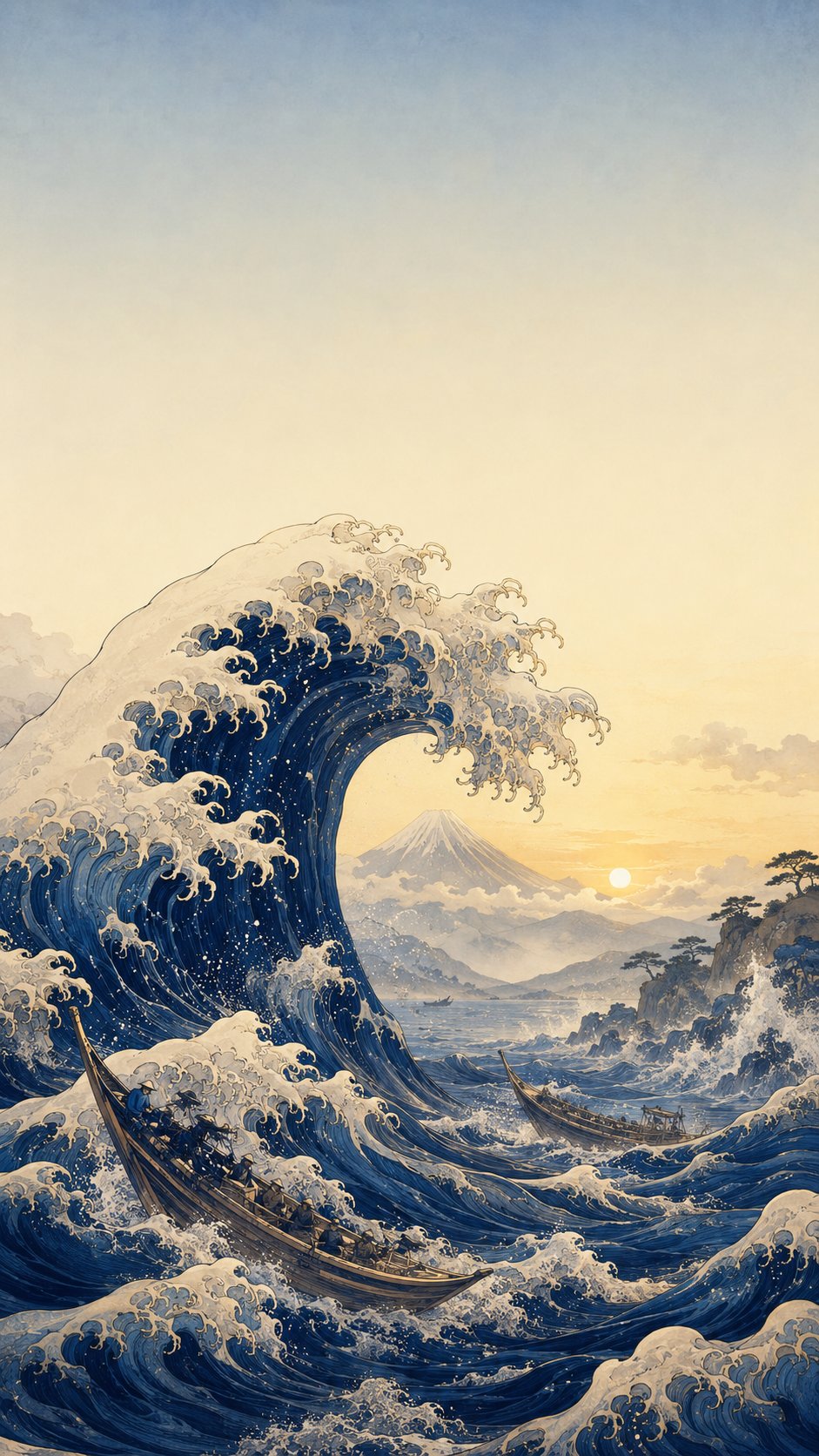
The Great Wave off Kanagawa by the Japanese artist Hokusai is not a single painting but a woodblock print, published around 1831. Carved blocks were inked and pressed onto paper by hand, and an estimated 8,000 copies were made; just over a hundred early ones survive in museums around the world.

Hokusai was about 71 when he made it as the first print of his series Thirty-six Views of Mount Fuji; the snow-capped mountain sits small behind the wave and three fishing boats. Japanese prints of this kind, called ukiyo-e (“pictures of the floating world”), were a team effort: the artist drew the design, a carver cut a separate woodblock for each colour, a printer inked the blocks and pressed the paper onto them, and a publisher, here Nishimuraya Yohachi, sold them. The deep blue is Prussian blue, a synthetic pigment newly imported from Europe that fades less than traditional indigo. About 1,000 copies were printed at first; as the blocks wore, later impressions lost detail. When Japan opened to the West in the later 19th century, such prints poured into Europe, and in 1905 Claude Debussy asked for the wave on the cover of his orchestral work La Mer.

WonderArt

Salvator Mundi, a painting of Christ attributed to Leonardo da Vinci, sold at Christie's in New York on 15 November 2017 for $450.3 million, the highest price ever paid for a painting at auction. Twelve years earlier, heavily overpainted and thought to be a copy, it had sold for $1,175.

Salvator Mundi is Latin for “Saviour of the World”. Two art dealers bought the dark, damaged panel at a New Orleans auction in 2005 and had it restored by Dianne Dwyer Modestini, who became convinced it was Leonardo's work. London's National Gallery exhibited it as a Leonardo in 2011, and in 2013 it changed hands twice, finally for $127.5 million. Experts still disagree about it. Some accept it as Leonardo's, others believe his assistants and pupils painted much of it, and others argue that the heavy restoration makes a firm verdict impossible. The buyer in 2017 was a Saudi prince, reported to be acting for Crown Prince Mohammed bin Salman. The painting has not been shown in public since the sale and is reported to be in storage in Saudi Arabia.

WonderArt

Mummy brown was a real artists' paint made from ground-up Egyptian mummies mixed with white pitch and myrrh. It was popular in Europe from the mid-1700s through the 1800s for shadows and skin tones, and fell out of use as mummies grew scarce and painters learned what it contained.

Long before it became a paint, material from Egyptian mummies was sold in Europe as a medicine. By 1712 a Paris colour shop called À la momie was selling powdered mummy alongside paints and varnish. The pigment gave a warm, see-through brown that suited glazes, thin transparent layers laid over other colours. The Victorian painter Edward Burne-Jones assumed the name only described the shade. In 1881, when his fellow painter Lawrence Alma-Tadema told him he had seen a mummy at a colour maker's waiting to be ground, Burne-Jones buried his tube in the garden. The paint also cracked and faded easily. In 1964 Time magazine reported that the London firm C. Roberson, the only remaining supplier, had run out of mummies. Paint sold as mummy brown today is made from iron oxide minerals and clay.

WonderArt

Leonardo da Vinci wrote most of his private notes in mirror writing: the letters run from right to left and are reversed, so they read normally in a mirror. When he wrote for other people, he used ordinary script.

Leonardo filled thousands of pages with notes and drawings on anatomy, flight, water, machines and painting, from shopping lists to designs for flying machines. The usual explanation for the mirror script is that he was left-handed: writing from right to left let his hand move away from the fresh ink instead of smudging it. The idea that he was hiding secrets is less convincing, since any mirror undoes the trick at once. After his death in 1519 the notebooks passed to his pupil Francesco Melzi and were later scattered. Today they are in collections such as the British Library and the Royal Library at Windsor Castle, and one, the Codex Leicester, was bought by Bill Gates in 1994 for about $30.8 million. Mirror writing also appears in Ottoman calligraphy, where mirrored compositions often carried a mystical meaning.

WonderArt

The Bayeux Tapestry tells the story of the Norman Conquest of England in 1066 across nearly 70 metres of linen. Despite its name it is not a tapestry, which is woven, but an embroidery: the pictures are stitched onto the cloth in coloured wool.

The cloth is about 50 centimetres tall and made of nine linen panels sewn together. Its 58 scenes, each with a short Latin caption, run from 1064 to the Battle of Hastings in 1066, where William, Duke of Normandy, defeated the English king Harold Godwinson. It shows more than 600 people, nearly a thousand animals, 41 ships and the earliest known picture of Halley's Comet. Most historians think it was commissioned by Bishop Odo of Bayeux, William's half-brother, and stitched in England, probably at Canterbury, in the 1070s, perhaps for the consecration of Bayeux Cathedral in 1077. The final section is missing. It takes its name from the town of Bayeux in Normandy, where it has been kept for most of its history, and it is listed on UNESCO's Memory of the World Register.

WonderArt

Oil paint is pigment ground in a drying oil such as linseed. It stays workable for days, so painters can blend soft transitions and build up thin, glowing layers. Netherlandish painters such as Jan van Eyck made it the main medium for pictures in the 15th century, and it soon spread across Europe.

Before oil, most European panel pictures were painted in egg tempera, which dries within minutes and has to be built up in small strokes. Oil does not dry by evaporating: it slowly reacts with oxygen in the air and hardens. That made glazes possible, thin transparent layers laid one over another so that light passes through them and reflects back from the white ground beneath, which gives skin and fabric their glow in paintings such as van Eyck's Arnolfini Portrait of 1434. Van Eyck did not invent oil paint, as the 16th-century writer Giorgio Vasari claimed. The oldest known oil paintings are Buddhist murals of about AD 650 in the caves of Bamiyan, Afghanistan, and a monk writing as Theophilus described oil painting in the early 12th century. In Venice, where sailcloth was easy to find, painters such as Titian moved from wooden panels to canvas in the 16th century.

WonderArt

Michelangelo's David, 5.17 metres tall, was carved in Florence between 1501 and 1504 from a single block of marble that other sculptors had begun and abandoned decades earlier. Michelangelo, then 26, turned the awkward, already-cut block into the first giant marble statue since ancient times.

The block came from the quarries of Carrara and was bought in 1465 for a statue meant to stand high on Florence Cathedral. The sculptor Agostino di Duccio roughed out the legs and body and then stopped; Antonio Rossellino was hired in 1476 but soon dropped the job. The block, nicknamed il Gigante, “the Giant”, lay in the cathedral workshop yard, and an inventory of 1500 described it as badly blocked out. Michelangelo won the contract on 16 August 1501. The earlier cutting helps explain why the statue is unusually slender from front to back. When it was finished it was judged too heavy to lift onto the cathedral, so it was set in the city's main square, the Piazza della Signoria, as a symbol of the Florentine Republic. It moved indoors to the Galleria dell'Accademia in 1873, and a copy now stands in the square.