
Courage, practice, momentum

Drive

For the next attempt.

Ideas for beginning, continuing and finding a useful move when certainty has not arrived.

527 cardsPage 14 of 22Context and sources

Editor’s note

The forward room

Drive is not a command to move faster. This edition gathers forms of momentum that can survive doubt: discipline, courage, repair, patience and the dignity of another attempt.

Q1618
WonderTechnology

In 1942 the actress Hedy Lamarr and composer George Antheil patented a way to stop radio-controlled torpedoes being jammed, by hopping the signal across frequencies. The same principle underlies wifi, GPS and Bluetooth.

Lamarr was billed as the most beautiful woman in the world and was bored by the parts she was given; she kept an inventing table at home. The frequency-hopping idea came with a mechanism synchronised by piano rolls — Antheil's contribution — and the US Navy filed the patent away unused. It expired before it earned either of them anything. Related techniques became fundamental to secure and shared wireless communication, and she was finally inducted into the National Inventors Hall of Fame in 2014, fourteen years after her death.

Q1619
WonderTechnology

When an oxygen tank exploded 320,000 km from Earth, three astronauts sheltered in a lunar module built for two. Engineers on the ground had to make its square air filters fit round sockets, using only what was aboard.

Carbon dioxide was climbing towards lethal levels. A team at Mission Control was handed a duplicate of every item on the spacecraft and told to build an adapter from it — the answer used plastic bags, cardboard from a flight manual, tape and a sock, read up to the crew step by step over the radio. It worked. The lunar module, never designed as a lifeboat, kept three men alive for four days, and all three came home. NASA called it a successful failure.

Q1629
WonderSpace

Before John Glenn orbited Earth in 1962, he did not trust the electronic computer's numbers. He asked for Katherine Johnson to work the trajectory by hand — and said if she agreed the figures were right, he was ready to go.

Johnson was one of NASA's 'human computers', a Black mathematician working in a segregated division at Langley. She calculated trajectories for Alan Shepard's flight, Glenn's orbit and later Apollo 11, and helped work out the return path that brought Apollo 13's crew home. She kept working at NASA until 1986, received the Presidential Medal of Freedom in 2015, and became widely known only late in life, after the book and film Hidden Figures.

Q1631
DriveLanguage

The Japanese word joins iki — life — with kai — worth. It names whatever makes your days feel worth living, and in Japan that is usually something small and ordinary: a garden, a grandchild, the walk to the shop.

The psychiatrist Mieko Kamiya gave the word its serious treatment in her 1966 book On the Meaning of Life, written after years working with patients at a sanatorium. For her ikigai was not a plan or a purpose to be solved, but the quiet sense that your days point somewhere worth waking for — and she found it in people whose circumstances were desperately hard. If you have ever come across a four-circle diagram promising to locate your ikigai where passion, skill, money and the world's needs overlap, that is a separate idea: it was drawn by a British blogger in 2014, adapting an earlier diagram about finding your purpose. The Japanese original asks far less of you, and gives more back.

Q1632
DriveArt

Cancer surgery left Henri Matisse unable to stand at an easel. Instead of stopping, he began cutting painted paper with scissors from his bed — and made the boldest work of his life.

After abdominal surgery in 1941 he was given months to live, and called the years that followed 'a second life'. Too weak to paint standing, he had assistants pin gouache-painted sheets to the walls of his room while he cut shapes with scissors and directed their placement from a wheelchair or bed. He called it drawing with scissors — the line and the colour arriving in a single cut. The cut-outs, made in his seventies and eighties, are now considered among the most radical things he ever did.

Q1633
DriveArt

Rheumatoid arthritis deformed Pierre-Auguste Renoir's hands so badly he could no longer grip. He kept painting for another twenty years, with brushes placed into his bandaged fingers.

By his sixties the disease had fused and twisted his joints, and he needed help to move. Assistants wrapped his hands and set a brush between his fingers so he could work by moving his whole arm and shoulder. He painted almost daily until the year he died, and in his last decade also took up sculpture, directing an assistant's hands to shape what he could no longer model himself. Asked why he continued through the pain, he is said to have replied that the pain passes, but the beauty remains.

Q1634
DriveArt

Cataracts turned Claude Monet's world muddy yellow and red. He kept painting the water lilies anyway, and after surgery in 1923 restored his sight, he went back and reworked canvases he had made half-blind.

Diagnosed in 1912, Monet described colours losing their intensity and reds looking muddy; he began labelling his tubes and keeping a fixed order on his palette so he could paint by system rather than by eye. Some canvases from those years are startlingly hot in tone. He resisted surgery for a decade, terrified it would ruin what vision he had, and finally had a lens removed in 1923. Seeing clearly again, he destroyed some of the works and reworked others. The great Orangerie panels were finished in this period.

Q1635
DriveArt

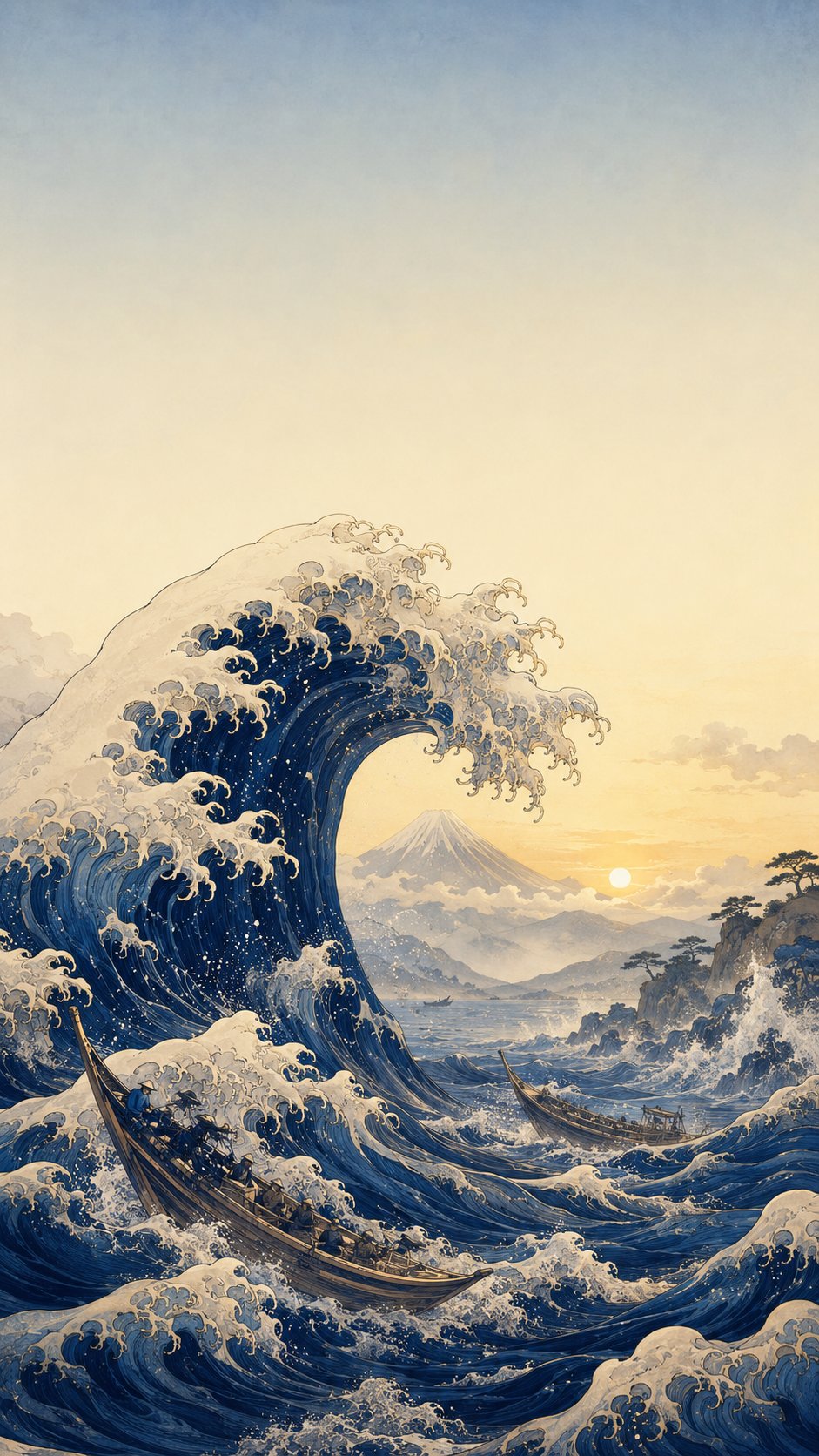
Hokusai — the artist behind the famous print of a curling blue wave — had already made it when he wrote that everything he produced before the age of seventy was not worth taking into account, and that by a hundred and ten every dot he made would be alive.

The passage comes from a postscript he wrote at about seventy-five. He describes drawing obsessively from the age of six, dismisses his entire earlier output, notes that at seventy-three he had begun to grasp the real structure of animals, plants and birds, and projects forward: at eighty he would make more progress, at ninety penetrate the mystery of things, at a hundred reach something marvellous. He signed some late work 'the old man mad about drawing', and kept working until he died at eighty-eight.

Q1636
DriveLiterature

John Milton lost his sight completely by 1652 and had backed the losing side of a civil war. Blind, politically disgraced and composing at night from memory, he dictated Paradise Lost to whoever would write it down.

He would hold long passages in his head overnight and wait, by his own account impatiently, to be 'milked' in the morning by a daughter, friend or paid amanuensis. The poem runs to more than ten thousand lines of blank verse and was published in 1667, after the Restoration had left him lucky to be alive at all. He sold the rights for £5, with a further £5 due on the second edition. He wrote in it that the mind is its own place, and can make a heaven of hell.

Q1641
DriveLanguage

Sisu is the Finnish word for the reserve you reach after your resolve has already gone — not courage before the ordeal, but the stubbornness that turns up once it should have ended.

Finns describe sisu as something closer to a deep-seated grit than to bravery or perseverance, and specifically as what remains when normal capacity is spent. The word is old, and became a national self-description during the Winter War of 1939–40, when a small Finnish army held out far longer than anyone expected against a Soviet invasion. Researchers at Helsinki have studied it as a psychological construct, distinguishing a healthy form from a harmful one — the kind that pushes past a limit that should have been respected.

Q1646
WonderLanguage

When Nicaragua opened its first schools for deaf children in the 1980s, the pupils had no shared language. Within a few years they had spontaneously created one — with grammar the adults had never taught them.

The children arrived using improvised home signs, unintelligible to one another. Thrown together, they built a shared pidgin — and then the younger intake did something remarkable: they regularised it, adding consistent grammatical structure their older schoolmates had not used. Each new cohort of young children made it more systematic. Linguists including Judy Shepard-Kegl and Ann Senghas documented it as it happened, making it the only time a human language has been observed being born. It suggests grammar is something children impose, not merely absorb.

Q1649
DriveMind

Reviewing something four times in one evening is far weaker than reviewing it four times across a month. The forgetting between sessions is not wasted — the effort of retrieval is what builds the memory.

Hermann Ebbinghaus identified it on himself in the 1880s, and it has since become one of the most reliably replicated findings in psychology. Cramming produces a feeling of fluency that predicts exam performance badly; spaced practice feels harder and works better, because each retrieval after partial forgetting strengthens the trace. The practical version is simple — review something a day later, then a few days later, then a fortnight later. Spaced-repetition software is built entirely on this, and medical schools and language learning have adopted it wholesale.

Q1650
DriveMind

Flow — losing track of hours in a task — is not luck. It arrives reliably when the challenge sits just above your current skill, the goal is clear, and feedback is immediate. Miss those and it does not come.

Mihaly Csikszentmihalyi interviewed climbers, surgeons, composers and chess players and found them describing the same state in almost identical words: absorbed, effortless, unselfconscious, unaware of time. His key finding was the balance point. Too easy and attention wanders into boredom; too hard and it collapses into anxiety. The narrow band between them is where flow lives, which is why it moves as you improve — what absorbed you last year will bore you next year unless the difficulty rises with you.

Q1653
DriveMind

Doing someone a kindness makes you warmer towards them, not just the other way round. Benjamin Franklin used it deliberately on a political rival — he asked to borrow a rare book, and made a lifelong friend.

Franklin described the tactic in his autobiography, noting the old maxim that someone who has already done you one kindness will be readier to do you another. The usual explanation is cognitive dissonance: having helped a person you disliked, the easiest way to make sense of your own behaviour is to decide you must quite like them. Laboratory studies in the 1960s found the pattern held. The practical lesson is counterintuitive but useful — a small, specific request can build a relationship faster than an offer of help.

Q1654
DriveHealth

Working muscle releases signalling molecules into the blood that reach the brain, liver, bone and immune system. Muscle is not just for moving — it is a gland you operate by using it.

The Danish physiologist Bente Klarlund Pedersen named these molecules myokines in 2003, and hundreds have since been identified. They help explain why exercise affects so much beyond fitness — mood, blood sugar handling, bone density, inflammation, and the brain's capacity to form new connections. It reframes what training is for: not primarily an appearance or a weight number, but the regular activation of a signalling organ that otherwise stays quiet. The dose required is far lower than most people assume.

Q1657
StillnessHealth

Sustained loneliness is associated with raised inflammation, higher blood pressure and worse immune response. Large reviews put its mortality risk in the same territory as well-known physical risk factors.

Julianne Holt-Lunstad's meta-analyses, covering hundreds of thousands of participants, found strong social relationships associated with a substantially higher likelihood of survival over follow-up. The effect held across age, sex and initial health. The causal direction is not fully settled — illness can cause isolation as well as follow it — but the association is robust enough that several countries now treat social connection as a public health priority. Quality matters more than quantity: a few close ties outperform a wide circle of acquaintances.

Q1658
DriveHealth

Adults lose roughly 3–8% of muscle mass per decade from their thirties, and faster after sixty. The loss is not inevitable at that rate — resistance training and adequate protein slow it sharply, at any age.

Sarcopenia is age-related loss of muscle mass and strength, and it matters far beyond appearance: muscle underpins balance, blood sugar regulation, bone loading and the ability to get up unaided. Trials in people in their eighties and nineties, including nursing-home residents, have produced substantial strength gains within weeks of starting supervised resistance work. Protein needs rise rather than fall with age, because older muscle responds less readily to the same amount. It is one of the few declines with a genuinely well-evidenced countermeasure.

Q1659
DriveHealth

Aerobic exercise raises levels of BDNF, a protein that supports the survival of existing neurons and the growth of new connections. It is one of the strongest physical supports for a sluggish mind.

Brain-derived neurotrophic factor has been called fertiliser for the brain. Levels rise with sustained aerobic activity, and animal studies link that rise to growth in the hippocampus, a region central to memory and badly affected by ageing and depression. Human trials have found modest but repeated improvements in memory and executive function after months of regular activity, alongside measurable hippocampal volume changes. The effective dose in most studies is unremarkable: brisk walking, most days, for around forty minutes.

Q1662
DriveScience

Katalin Karikó spent decades being told her work on mRNA was a dead end. She was demoted repeatedly and pushed off the tenure track. That work became the foundation of the mRNA covid vaccines, and won a Nobel Prize.

mRNA is the molecule that carries instructions from DNA to the cell's protein factories. Karikó's idea was to write your own instructions and have the body build the medicine itself — but injected mRNA triggered a violent immune response, and grant after grant was refused. At the University of Pennsylvania she was demoted four times. Working with Drew Weissman, she found in 2005 that swapping one building block let mRNA slip past the immune system. Fifteen years later that fix was in billions of arms, and in 2023 the two of them shared the Nobel Prize in Medicine.

Q1663
DriveTechnology

John Goodenough co-created the rechargeable battery that runs phones, laptops and electric cars. He received the Nobel Prize in 2019 at the age of 97 — the oldest person ever to be given one — and kept going into the lab afterwards.

He did not begin studying physics until after serving in the Second World War, and was told he was starting too late. He was 57 when he made the breakthrough that gave lithium batteries enough voltage to be useful. He never earned significant royalties from it. In his nineties he was still publishing, still chasing a safer solid-state battery, and reportedly said that he had no intention of retiring while he could still be useful. He died at 100.

Q1664
DriveHealth

Doctors were certain stomach ulcers came from stress and spicy food. Barry Marshall thought a bacterium caused them, could not get anyone to listen, and swallowed a dish of it to prove his point. He became ill within days.

In 1984, working in Perth with the pathologist Robin Warren, Marshall could not find an animal model and could not persuade the field. So he drank a broth of Helicobacter pylori. He developed gastritis, proved the bacterium colonised a healthy stomach, and treated himself with antibiotics. The implication was enormous: a disease affecting millions was curable with a short course of pills rather than managed for life. He and Warren received the Nobel Prize in Medicine in 2005.

Q1665
DriveScience

Alfred Wegener noticed that Africa and South America fit together like torn paper, and proposed in 1912 that the continents drift. Geologists ridiculed him. He was proved right decades after he died on the ice.

His evidence was good — matching coastlines, matching rock formations, identical fossils on shores now separated by an ocean. His weakness was that he could not explain what force could shove a continent. That gap let the field dismiss him, sometimes savagely; one geologist called it delirious ravings. Wegener died at fifty on a Greenland expedition, still unaccepted. In the 1960s, mapping of the sea floor revealed plates spreading apart, and the mechanism appeared. Plate tectonics is now the organising idea of the earth sciences.

Q1666
DriveScience

Gregor Mendel worked out the basic laws of inheritance by breeding pea plants in a monastery garden, and published in 1866. His paper was almost entirely ignored until sixteen years after his death.

He grew and counted some 28,000 pea plants over eight years, tracking traits like flower colour and seed shape, and found they were passed on in clean mathematical ratios. The work was rigorous and quantitative, which is precisely why the naturalists of the day did not know what to do with it. He was elected abbot and administration swallowed the rest of his life. In 1900 three separate botanists rediscovered his paper independently, and modern genetics started from it.

Q1667
DriveScience

Srinivasa Ramanujan worked as a shipping clerk in Madras with almost no formal training in mathematics. He posted pages of his own results to professors in England. One of them realised nobody could have invented them without being extraordinary.

He had failed college twice, because he would study nothing but mathematics. In 1913 he wrote to G. H. Hardy at Cambridge enclosing theorems Hardy had never seen. Hardy's reaction was that they must be true, because no one would have the imagination to invent them. Ramanujan came to England, produced work of extraordinary originality, and became one of the youngest ever Fellows of the Royal Society. He died at thirty-two. His notebooks are still yielding results a century on.

Move into another roomStillnessLet the noise settle.