Ways of seeing

Art

Artists, materials and images that changed how people look at the ordinary world.

186 entriesPage 6 of 8Context and sources

In this room

Follow the subject sideways.

Cards are connected by subject and by mood. Move through the complete sequence below, or cross into a neighbouring part of the archive.

36Drive
66Stillness
161Wonder
Q1579
WonderArt

The Amber Room was a chamber lined entirely in carved amber, gold and mirrors, called the eighth wonder of the world. German troops dismantled and shipped it in 1941, and it has not been seen since.

Built in Prussia and given to Russia's Peter the Great, it covered 55 square metres in six tonnes of amber lit by candles, glowing gold. During the invasion of the Soviet Union it was crated up and taken to Königsberg, and the trail ends there — burnt in the 1944 bombing, sunk on a ship, or hidden in a mine, depending on which theory you follow. Hunters still search. A full reconstruction, taking 24 years and using the original methods, opened near St Petersburg in 2003.

Q1580
WonderArt

Accused of selling a Dutch national treasure to the Nazis, Han van Meegeren faced execution for treason. His defence was that the painting was not a Vermeer at all — it was his own forgery. To prove it, he painted another one in his cell.

Van Meegeren was a mediocre painter dismissed by critics, so he set out to fool them. He aged canvases, mixed period pigments and baked his work to crack the varnish, then sold 'lost Vermeers' to the greatest experts of the day. One reached Hermann Göring. After the war that made him a collaborator, so he confessed to the lesser crime of fraud — and the court made him paint under supervision to check. He was convicted of forgery and became, briefly, a folk hero for having swindled the Reich.

Q1606
WonderHistory

In 1917 two Yorkshire cousins, aged 16 and 9, photographed themselves with fairies cut from a magazine and propped up with hatpins. Arthur Conan Doyle published the pictures as proof that fairies were real.

Elsie Wright and Frances Griffiths took the photographs to stop the adults teasing them about playing by the beck. Conan Doyle, grieving his son and deeply drawn to spiritualism, saw the images and championed them in The Strand Magazine. The pictures fooled a great many people for over sixty years. The cousins finally admitted the hoax in the 1980s — though Frances maintained to the end that the fifth and last photograph was genuine.

Q1632
DriveArt

Cancer surgery left Henri Matisse unable to stand at an easel. Instead of stopping, he began cutting painted paper with scissors from his bed — and made the boldest work of his life.

After abdominal surgery in 1941 he was given months to live, and called the years that followed 'a second life'. Too weak to paint standing, he had assistants pin gouache-painted sheets to the walls of his room while he cut shapes with scissors and directed their placement from a wheelchair or bed. He called it drawing with scissors — the line and the colour arriving in a single cut. The cut-outs, made in his seventies and eighties, are now considered among the most radical things he ever did.

Q1633
DriveArt

Rheumatoid arthritis deformed Pierre-Auguste Renoir's hands so badly he could no longer grip. He kept painting for another twenty years, with brushes placed into his bandaged fingers.

By his sixties the disease had fused and twisted his joints, and he needed help to move. Assistants wrapped his hands and set a brush between his fingers so he could work by moving his whole arm and shoulder. He painted almost daily until the year he died, and in his last decade also took up sculpture, directing an assistant's hands to shape what he could no longer model himself. Asked why he continued through the pain, he is said to have replied that the pain passes, but the beauty remains.

Q1634
DriveArt

Cataracts turned Claude Monet's world muddy yellow and red. He kept painting the water lilies anyway, and after surgery in 1923 restored his sight, he went back and reworked canvases he had made half-blind.

Diagnosed in 1912, Monet described colours losing their intensity and reds looking muddy; he began labelling his tubes and keeping a fixed order on his palette so he could paint by system rather than by eye. Some canvases from those years are startlingly hot in tone. He resisted surgery for a decade, terrified it would ruin what vision he had, and finally had a lens removed in 1923. Seeing clearly again, he destroyed some of the works and reworked others. The great Orangerie panels were finished in this period.

Q1635
DriveArt

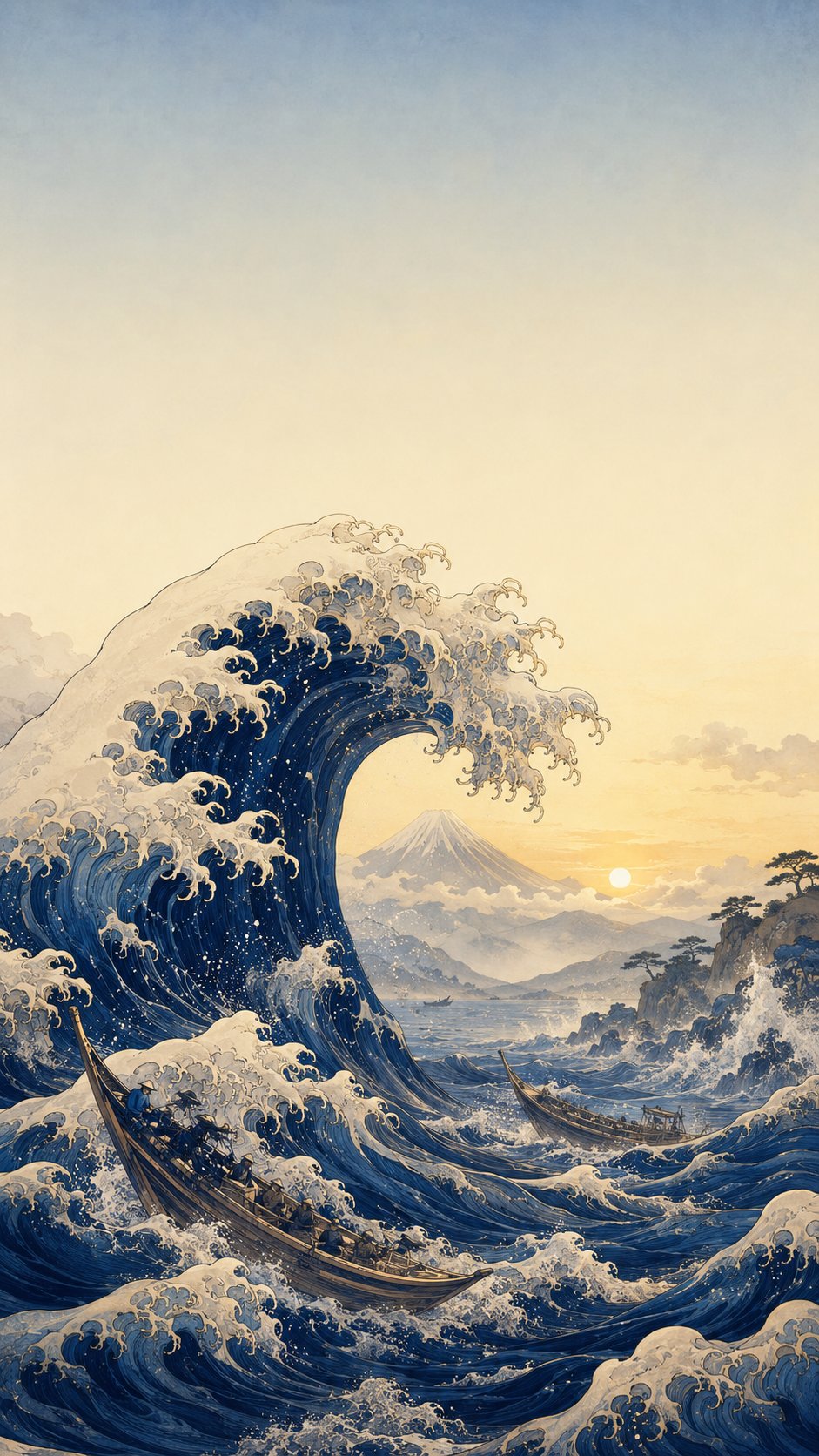
Hokusai — the artist behind the famous print of a curling blue wave — had already made it when he wrote that everything he produced before the age of seventy was not worth taking into account, and that by a hundred and ten every dot he made would be alive.

The passage comes from a postscript he wrote at about seventy-five. He describes drawing obsessively from the age of six, dismisses his entire earlier output, notes that at seventy-three he had begun to grasp the real structure of animals, plants and birds, and projects forward: at eighty he would make more progress, at ninety penetrate the mystery of things, at a hundred reach something marvellous. He signed some late work 'the old man mad about drawing', and kept working until he died at eighty-eight.

Q1637
StillnessArt

Wabi-sabi is the sense of beauty in things that are imperfect, impermanent and incomplete — a cracked bowl, a weathered post, a garden left slightly wild. It is beauty that admits time exists.

The two words started apart: wabi meant the loneliness of living simply, sabi the quiet that comes with age and wear. Joined, they name an aesthetic that runs through the tea ceremony, ceramics and garden design — rough textures, asymmetry, muted colour, and objects that show their history rather than hide it. It is a deliberate counterweight to the idea that beauty means flawless and new. The related craft of kintsugi takes it literally, mending broken pottery with gold so the repair becomes the most beautiful part.

Q1638
StillnessArt

'Ma' is the Japanese idea that the gap — the pause in music, the bare wall, the silence between words — is not absence waiting to be filled. It is an active part of the composition.

The character combines a gate with the sun showing through it: light in an opening. In architecture ma is the interval between columns, in music the rest between notes, in conversation the pause that carries the meaning. Western design tends to treat empty space as leftover; ma treats it as the element that gives everything else its weight. It shapes ink painting, garden design, noh theatre and modern Japanese graphic design — and it is why a nearly empty page can feel considered rather than unfinished.

Q1639
WonderArt

Ultramarine was ground from lapis lazuli, mined in one remote valley in Afghanistan and carried across Asia. It cost more by weight than gold, which is why Renaissance painters saved it for the Virgin's robe.

The name means 'beyond the sea' — the direction it arrived from. Contracts of the period specified how much ultramarine a patron was paying for, as they would specify gold leaf. Extracting a pure blue from the stone took days of grinding, kneading with wax and washing. In 1824 a French prize was offered for a synthetic version; it was met within a few years, and the colour that had signalled devotion and expense became available to anyone. Yves Klein later built an entire body of work around the shade.

Q1677
DriveArt

Vivian Maier worked as a nanny in Chicago and photographed the street obsessively for forty years. Almost none of it was printed or seen. The negatives surfaced at a storage auction in 2007, two years before she died unknown.

A young collector, John Maloof, bought a box of negatives for a few hundred dollars while researching a local history book. He found extraordinary street photography — sharp, humane, unsentimental — and started posting scans online. The response was immediate and international. Maier had kept rolls undeveloped, sometimes for decades, and told her employers almost nothing. She has since been exhibited worldwide, and the case raises an uncomfortable question the art world still argues about: whether work its maker never chose to show should be shown at all.
Q1685
DriveArt

A bus crash at eighteen broke Frida Kahlo's spine, pelvis and leg. Encased in plaster and unable to sit up, she had an easel built over her bed and a mirror set into the canopy — and painted the only subject in reach.

She had wanted to be a doctor. The accident in 1925 left her with injuries that required around thirty operations over her lifetime and long stretches flat on her back. Her mother had the mirror installed so she could see something; what she saw was herself, and roughly a third of her two hundred paintings became self-portraits. She was direct about why: she painted herself because she was so often alone, and because she was the subject she knew best. Her last major work was finished eight days before she died.

Q1686
DriveMusic

At thirty-one, losing his hearing, Beethoven wrote a private letter describing how close he had come to taking his own life, and what stopped him: the work he had not yet made. He went on to compose while completely deaf.

The letter was addressed to his brothers, never sent, and found among his papers after his death. In it he describes the humiliation of a musician who cannot hear, the isolation it forced on him, and his decision that it was unthinkable to leave the world before he had produced all he felt called to produce. He lived another twenty-five years. By the premiere of the Ninth Symphony in 1824 he could hear none of it, and had to be turned around to see the audience applauding. If this touches something in you, it is worth talking to someone you trust.

Q1687
DriveArt

Francisco Goya survived an illness that left him deaf, withdrew to a house outside Madrid, and covered its plaster walls with dark, private paintings he never named, never exhibited and never tried to sell.

He was in his seventies, had lived through war and famine, and was painting for no audience at all — there is no evidence he intended anyone to see them. They are unlike anything else of the period: raw, unresolved, closer to the twentieth century than the nineteenth. Decades after his death the murals were transferred from plaster onto canvas, a brutally difficult operation that damaged them, and moved to the Prado. He is the rare artist whose most radical work was made privately, in old age, with nothing to gain.

Q1688
DriveArt

Michelangelo was carving marble into his last week, and left behind a sketch inscribed 'ancora imparo' — I am still learning. He had by then been the most celebrated artist in Europe for over fifty years.

He worked on the Rondanini Pietà within days of his death at eighty-eight, reworking the same block so drastically that a previous version's arm still hangs from it. The phrase 'ancora imparo' is traditionally attributed to him rather than firmly documented, so treat the inscription as likely-but-not-certain — the working, however, is not in doubt. He was also chief architect of St Peter's in his eighties, and refused payment for it, saying he did the work for the love of God.

Q1695
DriveLanguage

Meraki means doing something with such care that something of you ends up in it — cooking, laying a table, finishing a wall. It is the difference between completing a task and leaving a trace.

The word came into Greek from Turkish merak, curiosity or keen interest, and shifted towards the soul or creative energy a person puts into what they make. Greeks apply it to ordinary work rather than art — a plate arranged with meraki, a room painted with it. The implication is quietly demanding: it is possible to do a job correctly and still not do it with meraki, and everyone can tell the difference, including you.

Q1711
WonderLanguage

In Jiangyong, China, women developed Nüshu — a slender script used in letters, songs and embroidery, passed between women when formal schooling was closed to most of them.

Nüshu means 'women's writing'. It grew in the Xiao River valley of Hunan province, where girls and women used it for sworn-sister letters, wedding laments and songs that could travel inside cloth. Its fine, tilted characters look almost like stitching because much of its life was bound to fans, booklets and embroidery. A script can be a shelter: a place to store feeling when the public language does not make room for you.

Q1720
WonderArt

The Benin Bronzes recorded court ritual, royal power, trade and memory in brass and bronze, long before museums turned them into display objects.

Many plaques once belonged in the royal palace at Benin City, where they honoured ancestors and preserved scenes of court life. Thousands of objects were taken after the British expedition of 1897, which is why any beautiful description now has to stand beside a harder one: these works are masterpieces, and they are also evidence in a live argument about return, repair and who gets to hold memory.

Q1721
DriveArt

Founded in 1919, the Bauhaus tried to reunite art, craft and industrial design, making the workshop a laboratory for modern life.

The school's life was short and politically battered, but its question lasted: what if a chair, lamp, building, poster and teapot deserved the same seriousness as a painting? In Dessau, steel, glass, typography, furniture and architecture became one conversation. The result can look clean to the point of severity, but the original impulse was generous — good form should enter ordinary rooms.

Q1723
WonderArt

Edvard Munch made several versions of The Scream, returning to the same figure and sky as if anxiety itself needed more than one attempt.

Munch called it a scream in nature, not merely a person screaming. That distinction matters. The figure is less a portrait than a receiver, a body tuned to a world that has become too loud. Because he repeated the motif in painting, drawing, pastel and print, it feels less like a single image than a pressure he kept trying to give form.

Q1724
WonderArt

The Venus de Milo entered the Louvre in 1821 as a rare Greek original, and its brokenness became part of the spell rather than a flaw to erase.

The statue is famous for ideal beauty, but also for absence. The lost arms make every viewer complete the pose in imagination: holding an apple, adjusting drapery, leaning on a shield, reaching toward someone just out of reach. Museums often try to stabilise meaning. This sculpture became more alive because part of its meaning stayed missing.

Q1725
WonderArt

In 2018 Banksy's Girl with Balloon passed through a shredder hidden in its frame seconds after auction, becoming the work Love is in the Bin.

The stunt worked because it attacked the exact room that had just priced the object. But the market absorbed the attack, certified it, named it and sold it again. That is the sharper joke. Destruction did not end the artwork; it became its provenance. Contemporary art often asks whether the frame is part of the work. Banksy made the frame bite back.