

The complete public collection

The living archive

Search across language, history, art, science and inner life. Every result opens into context, translation and a trail of related ideas.

1,961open cards
28subjects
2languages

Search and filter

Find the thought you came for.

1,961 cards, open to everyone

Three ways through

Begin with a state of mind.

Leave the route openGive me one unexpected idea

Archive ledger

1,961 cards, open to everyone

Page 66 of 82
Q1613
WonderNature

Jonathan, a giant tortoise on St Helena, hatched around 1832. He was already an adult when the telephone was invented, and he is still grazing the governor's lawn today.

He arrived on the island in 1882 as a gift, already fully grown, which put his hatching around 1832 — before the first photograph of a person, before the electric light, before Darwin published. He has seen 40 British monarchs' worth of governors come and go. Now blind and without a sense of smell, he is hand-fed and appears perfectly content. Guinness lists him as the oldest living land animal, and he features on the reverse of the St Helena five-pence coin.

Q1614
WonderNature

In 1925 diphtheria reached Nome, Alaska, with the sea frozen and no way in. Twenty mushers and about 150 dogs relayed the antitoxin 1,085 km in five and a half days through −50°C and a whiteout.

Balto got the statue in Central Park, but the hardest leg was run by Togo, a twelve-year-old husky who led Leonhard Seppala's team about 425 km — more than any other dog — including a crossing of unstable sea ice in a gale. Balto ran the final 88 km into town and met the photographers. Seppala was quietly bitter about it for years. The Iditarod race follows part of the route, and Togo has lately had his due, including a film named after him.

Q1615
WonderNature

Hachikō met his owner at Shibuya station each evening. When the professor died at work in 1925 and never came, the dog returned to the same spot at the same time every day for the next nine years and nine months.

Professor Hidesaburō Ueno of Tokyo Imperial University died of a haemorrhage during a lecture. Hachikō, an Akita, kept the appointment regardless. Commuters who had assumed he was a stray began feeding him once a newspaper told the story in 1932, and he became a national symbol of loyalty. A bronze statue was raised at Shibuya in 1934, with Hachikō present at the unveiling. He died the following year, near the station. The statue is still one of the most popular meeting points in Tokyo.

Q1616
WonderNature

A ship's cat known as Unsinkable Sam is said to have survived the sinking of the Bismarck in 1941, then two British destroyers, before being retired to a home for seamen in Belfast.

The story goes that a black-and-white cat was plucked from a plank after the Bismarck went down, taken aboard HMS Cossack, survived its torpedoing, was moved to the carrier HMS Ark Royal, and survived that too. Naval historians treat it as very likely embroidered — ships' cats were common, and a good yarn travels. A portrait of the cat hangs in the National Maritime Museum in Greenwich, filed carefully as legend rather than record. Some stories earn their keep either way.

Q1617
WonderNature

Old Tjikko looks like an ordinary small spruce on a Swedish mountainside. Its root system has been dated to around 9,550 years old — it has been regrowing its own trunk since the end of the last ice age.

The visible tree is only a few hundred years old; the organism beneath it is not. Norway spruce can clone itself by layering, where a branch touching the ground takes root and becomes a new trunk from the same genetic individual. Radiocarbon dating of the root material gave the extraordinary age. It survived the ice age as a low shrub and only grew upright as the climate warmed — a living thing that has been quietly present through the whole of human civilisation.

Q1618
WonderTechnology

In 1942 the actress Hedy Lamarr and composer George Antheil patented a way to stop radio-controlled torpedoes being jammed, by hopping the signal across frequencies. The same principle underlies wifi, GPS and Bluetooth.

Lamarr was billed as the most beautiful woman in the world and was bored by the parts she was given; she kept an inventing table at home. The frequency-hopping idea came with a mechanism synchronised by piano rolls — Antheil's contribution — and the US Navy filed the patent away unused. It expired before it earned either of them anything. Related techniques became fundamental to secure and shared wireless communication, and she was finally inducted into the National Inventors Hall of Fame in 2014, fourteen years after her death.

Q1619
WonderTechnology

When an oxygen tank exploded 320,000 km from Earth, three astronauts sheltered in a lunar module built for two. Engineers on the ground had to make its square air filters fit round sockets, using only what was aboard.

Carbon dioxide was climbing towards lethal levels. A team at Mission Control was handed a duplicate of every item on the spacecraft and told to build an adapter from it — the answer used plastic bags, cardboard from a flight manual, tape and a sock, read up to the crew step by step over the radio. It worked. The lunar module, never designed as a lifeboat, kept three men alive for four days, and all three came home. NASA called it a successful failure.

Q1620
WonderSpace

Many astronauts report the same experience on seeing Earth from space: a sudden, overwhelming sense that the planet is small, fragile, and has no visible borders. Researchers call it the overview effect.

The term was coined by the writer Frank White in 1987 after interviewing astronauts who kept describing the same shift. Accounts recur across nationalities and decades: a strong feeling of connection, an impatience with conflict, and a lasting protectiveness towards the planet. Several astronauts have returned to become environmental campaigners. Psychologists have since studied it as a form of awe — a state that reliably makes people feel smaller and more generous at the same time.

Q1621
WonderTechnology

In 1938 a chemist opened a cylinder of gas that weighed full but released nothing. He sawed it open and found the gas had turned itself into a white, slippery powder that almost nothing would stick to: Teflon.

Plunkett was working on refrigerants at DuPont. The tetrafluoroethylene had polymerised on the cylinder walls into PTFE, a substance so unreactive that acids do not touch it and so slippery it is among the lowest-friction solids known. Its first serious use was in the Manhattan Project, sealing equipment against ferociously corrosive uranium compounds. Frying pans came much later, after a French engineer's wife suggested putting it on cookware. Plunkett always described it plainly as an accident.

Q1622
WonderHealth

In the early 1990s a Welsh trial tested a new compound for angina. It did little for chest pain, but the men in the study were oddly reluctant to hand back the leftover tablets. The drug was renamed Viagra.

Sildenafil was designed to relax blood vessels and improve blood flow to the heart. It underperformed on that measure at Pfizer's trial site in Merthyr Tydfil, and the study was heading for closure when nurses reported the persistent side effect volunteers were declining to discuss in detail. The company changed direction, and it was approved in 1998. The same molecule is also used, under a different name, to treat pulmonary hypertension in babies — the use it was closest to being designed for all along.

Q1623
WonderFood

In the 1930s Ruth Wakefield chopped a bar of chocolate into her biscuit dough expecting it to melt through. It did not. The chunks held their shape, and the chocolate chip cookie existed by accident.

Wakefield ran the Toll House Inn in Massachusetts and was a trained dietitian, not a novice — the story that she was out of baker's chocolate and improvised is probably tidied up in the retelling. What is certain is the result was wildly popular. She sold the recipe to Nestlé; the widely repeated detail that she was paid one dollar and a lifetime supply of chocolate is disputed. Nestlé printed the recipe on its packaging, where a version of it remains today.

Q1624
WonderHistory

In 1590 an English relief ship reached the colony at Roanoke and found it deserted — houses dismantled, no bodies, no sign of struggle. Carved into a post was a single word: CROATOAN.

Governor John White had sailed to England for supplies and was delayed three years by war with Spain. He had agreed with the settlers that if they moved they would carve their destination, and add a cross if they left under duress. There was no cross. Croatoan was a nearby island and the name of a friendly people, which points to the least dramatic and most likely answer: they were absorbed into a local community. A storm forced White home before he could sail there, and he never returned.

Q1625
WonderHistory

In 1959 nine experienced Russian hikers cut open their tent from the inside and fled barefoot into −25°C. All died. The case stayed unexplained for sixty years.

The details fed decades of theory: some bodies had serious internal injuries but no external wounds, one was missing her tongue, and traces of radiation were found on clothing. Explanations ranged from avalanches to weapons tests. In 2021 researchers using models originally built for animating snow in films showed that a rare slab avalanche on that specific slope could produce exactly those crushing injuries — and would push people to cut out and run. Not everyone is convinced, but it is the first account that fits the evidence.

Q1626
WonderScience

Edward Cope and Othniel Marsh spent thirty years trying to destroy one another — bribing crews, stealing fossils, dynamiting their own sites so the other could not dig them. Between them they named around 130 new dinosaurs.

The feud filled American museums and gave the world Triceratops, Stegosaurus, Diplodocus and Allosaurus. It also produced spectacular sloppiness: Marsh built an Apatosaurus with the wrong skull, an error that stood in museums for decades, and Cope once assembled a plesiosaur with its head on the tail. Both men ruined their finances and reputations, and both died with far less than they started with. Palaeontology got its golden age out of two men who could not stand each other.

Q1627
WonderNature

In 1945 a Colorado farmer beheaded a cockerel for dinner and the bird got up and walked away. Mike the Headless Chicken lived another 18 months, fed by pipette, and toured the country.

The axe missed most of the brainstem, which controls breathing and heart rate, and a clot sealed the artery so he did not bleed out. One ear and much of the stem stayed attached, so basic functions carried on. Lloyd Olsen fed him milk and water through an eyedropper and took him on tour, where thousands queued to see him. He died in a motel when Olsen could not find the feeding equipment in time. The town of Fruita still holds a Mike the Headless Chicken festival each spring.

Q1628
WonderHistory

In 1938 a radio drama told American listeners that Martians were landing in New Jersey. The story that it sent the country into mass hysteria is largely a newspaper invention — very few people actually panicked.

Ratings show the audience was small; the popular show on a rival station took most listeners that night. Newspapers, losing advertising to radio, ran hundreds of stories about mobs and suicides that could not be verified afterwards. Some listeners were certainly alarmed, and a few rang the police — but nothing like a national stampede. The tale endured because it is a better story than the truth, which is itself a decent lesson in how panics get made.

Q1629
WonderSpace

Before John Glenn orbited Earth in 1962, he did not trust the electronic computer's numbers. He asked for Katherine Johnson to work the trajectory by hand — and said if she agreed the figures were right, he was ready to go.

Johnson was one of NASA's 'human computers', a Black mathematician working in a segregated division at Langley. She calculated trajectories for Alan Shepard's flight, Glenn's orbit and later Apollo 11, and helped work out the return path that brought Apollo 13's crew home. She kept working at NASA until 1986, received the Presidential Medal of Freedom in 2015, and became widely known only late in life, after the book and film Hidden Figures.

Q1630
WonderFood

In 1894 two brothers running a Michigan sanitarium left boiled wheat standing for a day. It went stale, and rolling it produced flakes instead of sheets. Breakfast has never recovered.

The Kelloggs were trying to make an easily digestible food for patients. The staleness had let the moisture distribute evenly, so each grain flaked separately under the rollers. Patients loved it. The brothers then fell out badly: Will wanted to add sugar and sell it widely, John thought that betrayed the health mission, and they spent years in court over the family name. Will's company became Kellogg's, and the accidental flake became one of the most eaten manufactured foods on Earth.

Q1631
DriveLanguage

The Japanese word joins iki — life — with kai — worth. It names whatever makes your days feel worth living, and in Japan that is usually something small and ordinary: a garden, a grandchild, the walk to the shop.

The psychiatrist Mieko Kamiya gave the word its serious treatment in her 1966 book On the Meaning of Life, written after years working with patients at a sanatorium. For her ikigai was not a plan or a purpose to be solved, but the quiet sense that your days point somewhere worth waking for — and she found it in people whose circumstances were desperately hard. If you have ever come across a four-circle diagram promising to locate your ikigai where passion, skill, money and the world's needs overlap, that is a separate idea: it was drawn by a British blogger in 2014, adapting an earlier diagram about finding your purpose. The Japanese original asks far less of you, and gives more back.

Q1632
DriveArt

Cancer surgery left Henri Matisse unable to stand at an easel. Instead of stopping, he began cutting painted paper with scissors from his bed — and made the boldest work of his life.

After abdominal surgery in 1941 he was given months to live, and called the years that followed 'a second life'. Too weak to paint standing, he had assistants pin gouache-painted sheets to the walls of his room while he cut shapes with scissors and directed their placement from a wheelchair or bed. He called it drawing with scissors — the line and the colour arriving in a single cut. The cut-outs, made in his seventies and eighties, are now considered among the most radical things he ever did.

Q1633
DriveArt

Rheumatoid arthritis deformed Pierre-Auguste Renoir's hands so badly he could no longer grip. He kept painting for another twenty years, with brushes placed into his bandaged fingers.

By his sixties the disease had fused and twisted his joints, and he needed help to move. Assistants wrapped his hands and set a brush between his fingers so he could work by moving his whole arm and shoulder. He painted almost daily until the year he died, and in his last decade also took up sculpture, directing an assistant's hands to shape what he could no longer model himself. Asked why he continued through the pain, he is said to have replied that the pain passes, but the beauty remains.

Q1634
DriveArt

Cataracts turned Claude Monet's world muddy yellow and red. He kept painting the water lilies anyway, and after surgery in 1923 restored his sight, he went back and reworked canvases he had made half-blind.

Diagnosed in 1912, Monet described colours losing their intensity and reds looking muddy; he began labelling his tubes and keeping a fixed order on his palette so he could paint by system rather than by eye. Some canvases from those years are startlingly hot in tone. He resisted surgery for a decade, terrified it would ruin what vision he had, and finally had a lens removed in 1923. Seeing clearly again, he destroyed some of the works and reworked others. The great Orangerie panels were finished in this period.

Q1635
DriveArt

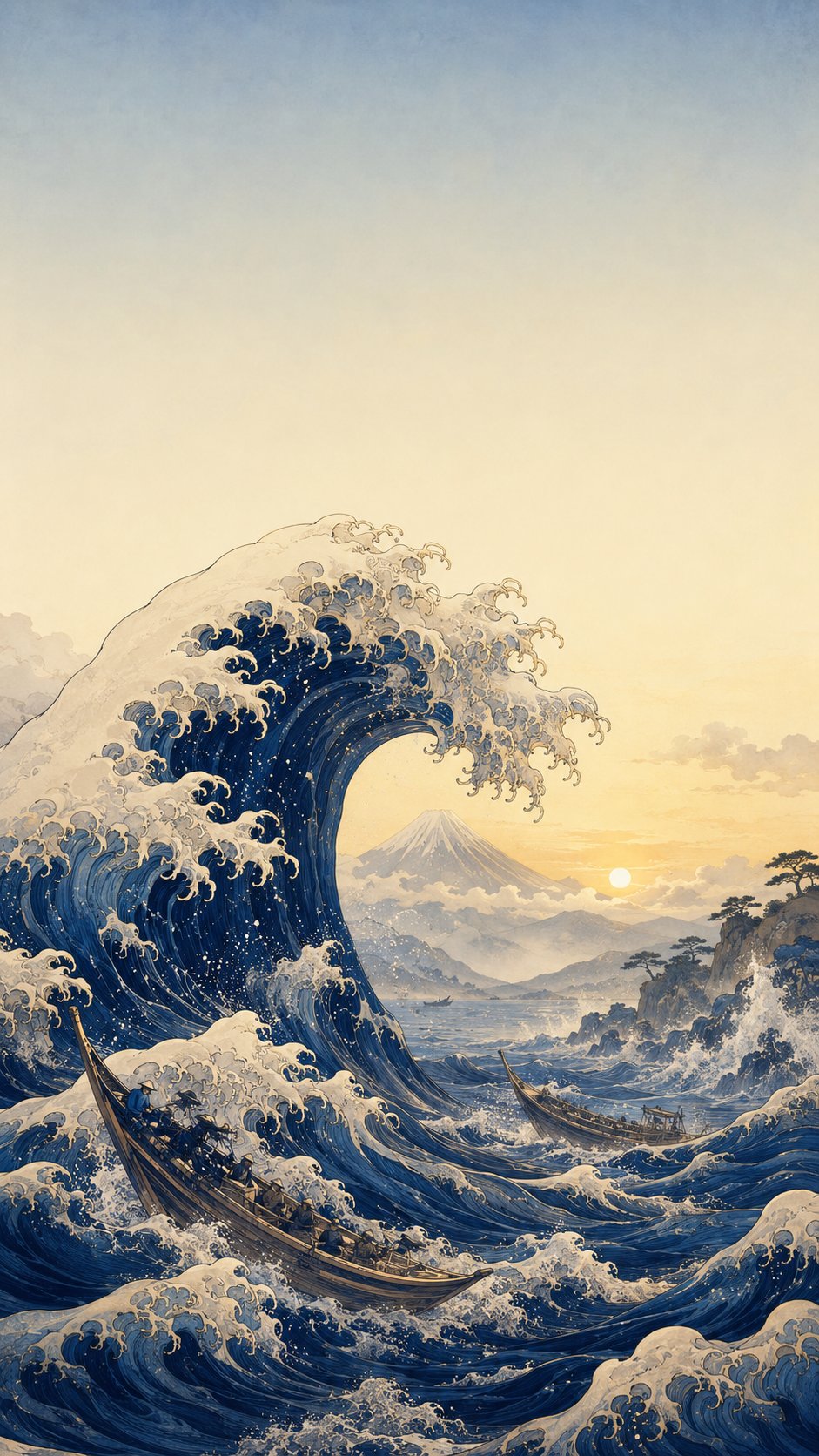
Hokusai — the artist behind the famous print of a curling blue wave — had already made it when he wrote that everything he produced before the age of seventy was not worth taking into account, and that by a hundred and ten every dot he made would be alive.

The passage comes from a postscript he wrote at about seventy-five. He describes drawing obsessively from the age of six, dismisses his entire earlier output, notes that at seventy-three he had begun to grasp the real structure of animals, plants and birds, and projects forward: at eighty he would make more progress, at ninety penetrate the mystery of things, at a hundred reach something marvellous. He signed some late work 'the old man mad about drawing', and kept working until he died at eighty-eight.