
Science, art, nature, language

Wonder

Something new to discover.

Ideas and discoveries from science, art, nature and language.

Reading modePage 6Context and sources

Editor’s note

Wonder

For the pleasure of learning something you did not know, from an unfamiliar artist to a surprising discovery.

WonderScience

A neutron star packs one to two times the mass of the Sun into a ball only about 20 km across, the size of a city. It is the collapsed core left behind when a massive star explodes.

When a star of roughly 10 to 25 times the Sun's mass dies in a supernova explosion, its core collapses so violently that protons and electrons are pressed together into neutrons, packed as tightly as in the nucleus of an atom. That is where NASA's comparison comes from: a sugar cube of this material would weigh about a trillion kilograms on Earth, about as much as a mountain. The first evidence that such stars exist came in 1967, when Jocelyn Bell (later Bell Burnell), a graduate student at the University of Cambridge working with Antony Hewish, picked up a radio signal pulsing with clockwork regularity. It came from a pulsar, a spinning neutron star that sweeps a beam across space like a lighthouse. The fastest known pulsar turns 716 times a second.
WonderScience

Black holes are not cosmic vacuum cleaners. From a distance, a black hole pulls on things just as a star of the same mass would; only very close to it does its gravity become inescapable.

Gravity depends on mass and distance, and a black hole is a very large mass squeezed into a tiny space. If the Sun were somehow crushed into a black hole of the same mass, it would be only about 6 km across, yet Earth would keep orbiting just as it does now; the days would simply turn dark and cold. The danger starts near the event horizon, the boundary beyond which nothing, not even light, can get back out. At the centre of our galaxy, about 26,000 light-years away, lies Sagittarius A*, a black hole of about four million Suns. Stars orbit it on steady paths, and tracking one of them, S2, was part of the work that won Reinhard Genzel and Andrea Ghez the 2020 Nobel Prize in Physics.

WonderScience

Sunlight takes about 8 minutes 20 seconds to cross the 150 million km between the Sun and Earth, so we always see the Sun as it was a little over eight minutes earlier.

Light travels at about 300,000 km per second. The Sun is on average about 150 million km away, so its light takes about 8 minutes 20 seconds to reach us: a little less in early January, when Earth is closest to the Sun, and a little more in early July. The Danish astronomer Ole Rømer showed in 1676 that light takes time to travel. Working in Paris, he noticed that the gaps between eclipses of Io, one of Jupiter's moons, grew longer while Earth was moving away from Jupiter and shorter while it was moving closer, because the light had a longer or shorter distance to cover. The energy in sunlight is far older than eight minutes: it is made in the Sun's core, and working its way out to the surface is estimated to take 10,000 to 170,000 years.

WonderScience

Looking into deep space is also looking back in time, because light from distant stars and galaxies takes time to reach us.

Light is fast but not instant: it covers about 300,000 km every second. We see the Moon as it was about 1.3 seconds ago, the Sun as it was about eight minutes ago, and Proxima Centauri, the nearest star beyond the Sun, as it was about 4.2 years ago. Astronomers measure such distances in light-years, the distance light travels in a year, about 9.5 trillion km. The Andromeda Galaxy, one of the most distant things visible to the naked eye, is about 2.5 million light-years away, so the light we see left it 2.5 million years ago. This delay lets telescopes study the young universe directly. In 2025 the James Webb Space Telescope photographed a galaxy called MoM-z14 as it was about 280 million years after the Big Bang. The oldest light of all, the cosmic microwave background, was released about 380,000 years after the Big Bang.

WonderScience

Almost all of an atom's mass sits in a tiny nucleus at its centre; the atom's size comes from the far larger cloud of electrons around it. When you press on a table, the electron clouds of its atoms and yours push back against each other, so your hand does not pass through.

We know how small the nucleus is thanks to experiments at the University of Manchester. In 1909 Hans Geiger and Ernest Marsden, working with Ernest Rutherford, fired alpha particles, tiny fragments shot out by radioactive atoms, at a very thin sheet of gold. Most went straight through, but a few bounced sharply back. In 1911 Rutherford concluded that almost all of an atom's mass is packed into a tiny central nucleus. We now know it holds more than 99.9% of the mass and is 27,000 to 60,000 times narrower than the atom. Two effects keep atoms from overlapping. Electrons all carry negative charge, so they repel each other. And the Pauli exclusion principle, a rule of quantum physics stated by Wolfgang Pauli in 1925, forbids two electrons from being in exactly the same state, so electron clouds resist being squeezed together.

WonderScience

How hot or cold an object feels depends not only on its temperature but also on how quickly it transfers heat to or from your skin.

Your skin is usually a little over 30°C, warmer than a room at about 20°C. When you touch something, heat flows out of your skin, and the nerve endings that sense warmth and cold respond mainly to how fast that happens. Metals conduct heat extremely well: aluminium, for example, conducts it more than a thousand times better than wood. So a metal handle draws heat from your fingers quickly and feels cold, while a wooden one lets your skin stay warm. Engineers call the property that matters here thermal effusivity: it combines how well a material conducts heat with how much heat it can soak up. The same rule works in reverse: in a sauna at 80°C or more you can sit on a wooden bench, but a metal one at that temperature would burn you. It is also why a tiled floor feels colder underfoot than a rug.

WonderScience

Diamond, the hardest natural material, and graphite, the soft grey stuff in pencils, are both pure carbon. The difference is how the atoms are linked: a rigid three-dimensional framework in diamond, and flat sheets that slide over each other in graphite.

Diamond and graphite are allotropes: different forms of the same element. In diamond, each carbon atom is locked to four neighbours in a rigid three-dimensional framework, which is why diamond is so hard. In graphite, each atom bonds to three neighbours in flat sheets. The sheets hold on to each other only weakly and slide apart easily, which is why a pencil leaves a grey trail on paper. Graphite conducts electricity; diamond does not. Most natural diamonds formed 150 to 250 km down in Earth's mantle, under great heat and pressure. Graphene is a single sheet of graphite, just one atom thick. It was first isolated in 2004 at the University of Manchester by Andre Geim and Konstantin Novoselov, who peeled flakes off graphite with ordinary sticky tape, and it won them the 2010 Nobel Prize in Physics.

WonderScience

The smell after rain is partly caused by geosmin, a compound made by soil bacteria and released into the air by falling drops.

The smell of rain has a name: petrichor. The word was introduced in 1964 by the Australian researchers Isabel Joy Bear and Richard Thomas, from the Greek petra, stone, and ichor, the fluid said to flow in the veins of the gods. Part of the scent comes from plant oils that collect in dry soil and rock; another part is geosmin, made by soil bacteria such as Streptomyces. Our noses are extraordinarily sensitive to it: most people can smell it in water at only 6 to 10 parts per trillion. In 2015 researchers at MIT filmed raindrops with high-speed cameras and found that a drop landing on dry, porous ground traps tiny air bubbles, which rise and burst into a fine spray that carries the scent into the air. Geosmin also gives beetroot its earthy taste.

WonderTechnology

Telomeres are stretches of repeated DNA that cap the ends of chromosomes, a little like the plastic tips on shoelaces. They get shorter as many of our cells divide, but their length cannot predict how long a particular person will live.

In the mid-1970s the Australian-born biologist Elizabeth Blackburn, working at Yale, found that chromosome ends carry a short DNA “word” repeated many times; in humans it is TTAGGG. She shared the 2009 Nobel Prize in Physiology or Medicine with Carol Greider and Jack Szostak for showing how telomeres, and an enzyme called telomerase that rebuilds them, protect chromosomes. Each time most body cells divide, the copying machinery cannot quite reach the very end, so a little telomere is lost; when it gets too short, the cell stops dividing, which is why telomeres are often called a clock. But it is a poor clock for comparing people or species: mice have much longer telomeres than humans yet live only two or three years, and telomere length varies widely between people from birth. Many scientists therefore doubt commercial tests that claim to read your “biological age” from them.

WonderTechnology

The atomic clocks on GPS satellites run about 38 millionths of a second a day faster than clocks on the ground, an effect predicted by Einstein's theories of relativity. Left uncorrected, the drift would put your position out by about 11 km within a single day.

A GPS receiver, such as the one in your phone, works out where it is by timing signals from several satellites orbiting about 20,200 km up. Radio signals travel about 300 metres in a microsecond, a millionth of a second, so even tiny clock errors matter. Relativity pulls the clocks apart in two ways. Special relativity says moving clocks run slow: travelling at almost 4 km a second, the satellite clocks lose about 7 microseconds a day. General relativity says clocks in weaker gravity run fast: high above Earth they gain about 46. The net gain is about 38 microseconds a day. So before launch, each satellite clock is set to run slightly slow, at 10.22999999543 million cycles a second instead of 10.23 million, and in orbit it keeps step with clocks on the ground.

WonderTechnology

The Apollo Guidance Computer that steered astronauts to the Moon had about 4 kilobytes of rewritable memory and 72 kilobytes of permanent memory. Its programs were woven by hand into “rope memory”: a wire threaded through a tiny magnetic ring stored a 1, and a wire passing it by stored a 0.

Designed at the MIT Instrumentation Laboratory and built by Raytheon, the computer was one of the first to use silicon chips (integrated circuits) and fitted into about 28 litres. Its memory was counted in “words” of 16 bits, or binary digits: 2,048 rewritable and 36,864 permanent. During Apollo 11's descent on 20 July 1969 it flashed 1202 and 1201 alarms: a radar left on in case the landing had to be abandoned was stealing processing time and overloading it. Its operating system, designed by J. Halcombe Laning, dropped less urgent jobs and restarted in a moment while the landing programs kept running, so Mission Control told the crew to carry on. The flight software was written by a team led by Margaret Hamilton, who received the Presidential Medal of Freedom in 2016. Its power was similar to that of the first home computers of the late 1970s.

WonderTechnology

In 1984 and 1985, John Clarke, Michel Devoret and John Martinis showed that a whole electrical circuit on a chip, cooled almost to absolute zero, can behave as a single quantum object, just like an atom. The discovery earned them the 2025 Nobel Prize in Physics.

The experiments were done at the University of California, Berkeley, in Clarke's group; Martinis was his doctoral student and Devoret a postdoctoral researcher. Absolute zero, −273.15 °C, is the lowest temperature possible. At the heart of the circuit was a Josephson junction: two superconductors, metals that carry current with no resistance when very cold, separated by an insulating layer only a few atoms thick. Vast numbers of electrons moved together as if they were one particle. The team saw two signs of quantum behaviour: the circuit escaped from a trapped state by tunnelling, slipping through an energy barrier it could not climb over, and it absorbed microwave energy only in fixed steps, or quanta, as an atom does. Circuits of this kind are now the qubits, the basic units of information, in the superconducting quantum computers built by companies such as Google and IBM.

WonderTechnology

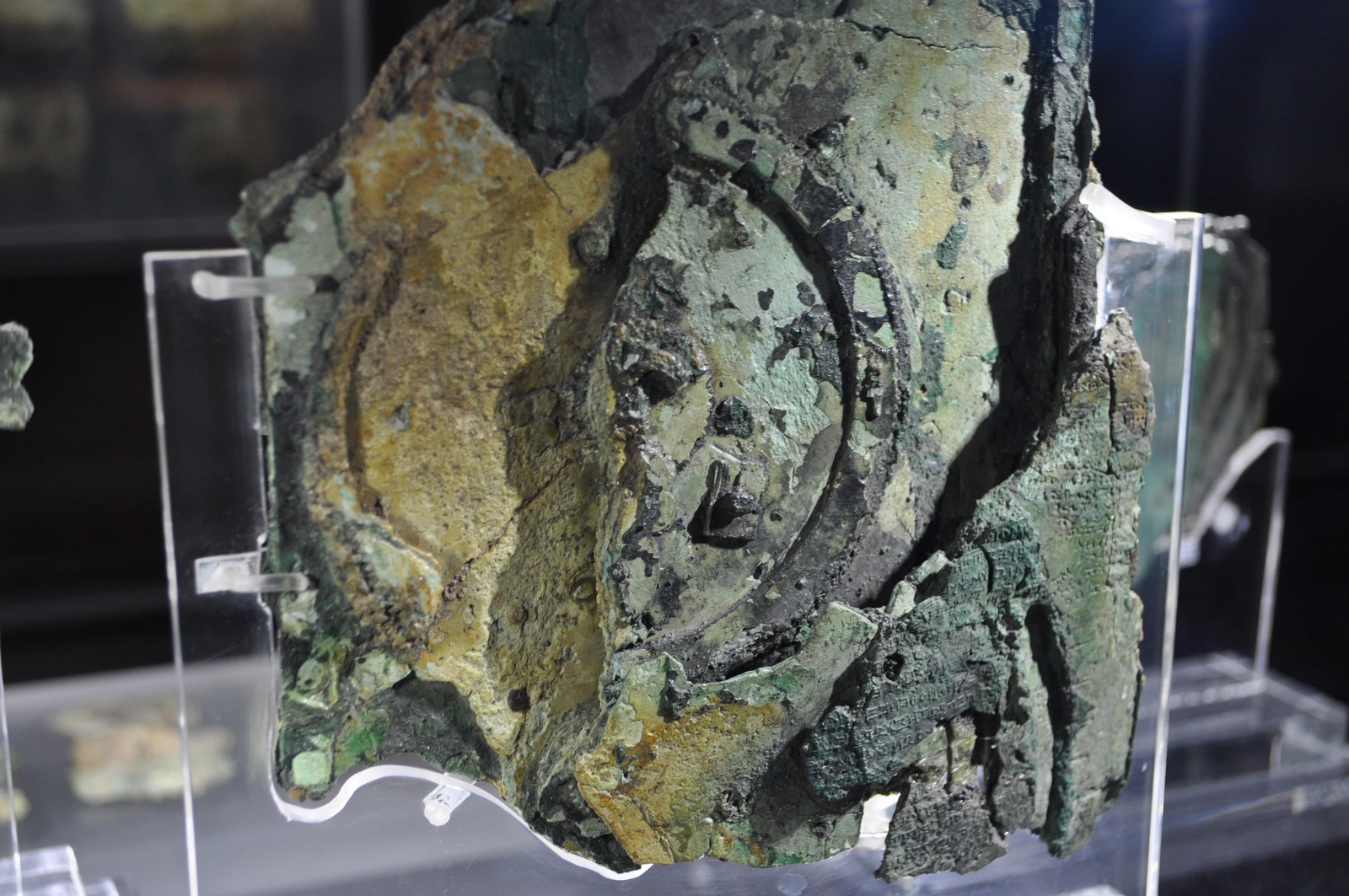
The Antikythera mechanism, an ancient Greek geared device probably made in the 2nd century BC, had a spiral dial covering 223 lunar months for predicting eclipses. Symbols on the dial marked the months when an eclipse of the Sun or Moon was expected, and inscriptions gave details such as the hour.

Sponge divers found the mechanism in 1901, a corroded lump among treasures from a Roman-era ship that sank off the Greek island of Antikythera around 70 to 60 BC. Its hand-turned bronze gears modelled the movements of the Sun and Moon, and it is called the oldest known analogue computer, a machine that calculates with moving parts rather than digits. The eclipse dial follows the Saros cycle: after 223 lunar months (new moon to new moon), about 18 years and 11 days, the Sun, Earth and Moon return to almost the same positions, so eclipses repeat in a similar pattern. Symbols in 51 of the dial's cells mark 38 lunar and 27 solar eclipses. Much of this was read only in the 2000s, when researchers including Mike Edmunds and Tony Freeth used X-ray scans to see inside the fragments. The front, which probably showed the planets, is largely lost.

WonderTechnology

Paper money was first used in China. In the early 11th century, merchants in Sichuan began issuing paper notes called jiaozi in place of heavy iron coins, and in 1023 the Song government took over issuing them. Europe's first banknotes appeared in Sweden in 1661.

The idea had roots in the Tang dynasty (618–907): by 804, merchants were using “flying cash”, paper certificates that let them move money across China without carrying coins. In Sichuan, where iron coins were too heavy for large payments, private firms in the regional capital, Chengdu, began issuing jiaozi notes. When some issuers went bankrupt, the state set up its own office in 1023 and printed the first government notes the following year. Paper money rested on trust: a note was worth only what its issuer promised. That trust could be abused, and when the Song printed far more notes than they could back with coins, prices soared. Europeans learnt of paper money from travellers such as Marco Polo, who described the Mongol emperor Kublai Khan's notes in the 13th century. Europe's first banknotes came from Stockholms Banco in 1661; the bank failed six years later.

WonderTechnology

The magnetic compass began in China as a tool for fortune-telling and geomancy, the art of siting houses and tombs in harmony with the land. The first records of Chinese sailors steering by a magnetised needle date from the early 12th century.

The first Chinese direction-finders were probably “south-pointing spoons” made of lodestone, a naturally magnetic iron ore. Placed on a smooth bronze board marked with directions, the spoon turned until its handle pointed south. Texts from the Han dynasty (206 BC to AD 220) appear to describe such devices, although archaeologists have not yet found one. The big step came under the Song dynasty. In 1088 the scholar Shen Kuo described needles magnetised by rubbing them on lodestone, and noticed that they do not point exactly north-south, the effect now called magnetic declination. A few decades later the writer Zhu Yu recorded that sailors steered by the stars at night and the sun by day, and turned to the south-pointing needle when the sky was overcast. In Europe, the first written mention of a compass dates from about 1190.

WonderTechnology

Gunpowder, a mixture of saltpetre, sulphur and charcoal, was discovered in China in the 9th century by alchemists searching for an elixir of long life. Its Chinese name, huoyao, still means “fire medicine”. Carried west over the following centuries, it changed warfare across the world.

The first confirmed recipes appear in Taoist alchemy books of the Tang dynasty: one dated 808, and another from about 50 years later, the Zhenyuan miaodao yaolüe, which warns that people who heated saltpetre and sulphur with honey had burnt their hands and faces, and even their whole house. Saltpetre (potassium nitrate) releases oxygen when heated, which is why the mixture burns so fiercely. Chinese armies used it in fire arrows and bombs, and the military handbook Wujing Zongyao, finished in 1044, gives the earliest written formulas for military use. By the 12th century soldiers carried “fire lances”, tubes that shot flames and later bullets. Gunpowder reached the Islamic world and Europe in the 13th century; the English friar Roger Bacon described it in 1267. In 1453 the Ottoman sultan Mehmed II used huge cannons to breach the walls of Constantinople.

WonderTechnology

Before standard time, each town kept its own time by the sun: noon was when the sun stood highest in its sky. Because the Earth turns one degree every four minutes, noon in Bristol came about ten minutes after noon in London.

Town clocks usually showed local mean time: sundial time averaged over the year, because the real sun runs up to about a quarter of an hour fast or slow across the seasons. The difference grew with distance east or west. In Britain, Oxford was five minutes behind London and Leeds six; in India and North America, cities could be an hour or more apart. That hardly mattered while journeys took days, but trains and the telegraph made it a problem. North American railways switched to five standard time zones on 18 November 1883, and in 1884 delegates from 25 countries meeting in Washington chose the meridian through Greenwich as the world's zero line of longitude. The Ottoman Empire had its own system, alaturka time, which reset clocks to 12 at every sunset; Turkey replaced it with the international 24-hour day in 1926.

WonderTechnology

Railways pushed Britain onto one national time. In November 1840 the Great Western Railway began running its trains on London time; by the end of 1847 almost every British railway had followed, and in 1880 Greenwich Mean Time became Great Britain's legal time.

London time was set by the Royal Observatory at Greenwich, so it was known as Greenwich Mean Time, or simply “railway time”. The patchwork of local times caused confusion, missed connections and near misses between trains. Some towns resisted. The clock on Bristol's Exchange was given a second minute hand for London time, and it still shows both; Exeter held out until 1852 because the Dean of its cathedral, whose clock set the city's time, refused to change it. The electric telegraph settled the matter: from the 1850s, time signals from Greenwich ran along wires beside the tracks, and by 1855 almost every town in Britain kept GMT. Parliament made it the legal time for Great Britain on 2 August 1880.

WonderTechnology

Louis Daguerre's 1838 photograph of the Boulevard du Temple in Paris shows a busy street as almost empty: the exposure took minutes, so moving people and carriages left no trace. The only clear figures are a man having his boots polished and, probably, the shoe-shiner, who kept still long enough to show up.

Daguerre, a French painter of theatre scenery, took the picture from his studio window at eight in the morning in late April or early May 1838 (possibly 1837). In his process, the daguerreotype, the image formed directly on a silver-coated copper plate. It cut the exposure from the eight hours or more needed for the oldest surviving photograph, taken by Nicéphore Niépce in the 1820s, to four or five minutes: still far too long for walkers and carriages. Like every daguerreotype, the picture is a mirror image. Daguerre announced his invention in January 1839 and that October gave this plate to King Ludwig I of Bavaria. The original was later ruined by a failed restoration, so the image we know comes from copies made in the 1930s by the photography historian Beaumont Newhall.

WonderTechnology

On 28 December 1895, Auguste and Louis Lumière held a paid film show in the Salon Indien of the Grand Café in Paris, traditionally counted as the birth of cinema. With their Cinématographe they projected ten films, each under a minute long: real movement could now be replayed after the moment had passed.

The Cinématographe, patented by the brothers in February 1895, was a portable, hand-cranked box that worked as camera, printer and projector in one. The Lumière family ran a factory in Lyon making photographic plates, and their first film showed its workers streaming out of the gates. Films had been shown before: the brothers had projected this one on 22 March 1895 to about 200 members of a French society for industry, and in Berlin the Skladanowsky brothers had screened films for a paying audience on 1 November. The December show drew around 40 paying visitors and invited guests. The famous Arrival of a Train at La Ciotat was not in that programme; it was first shown in January 1896, and historians have found no report from the time of audiences fleeing from the screen.

WonderTechnology

In 1945 six women, chosen from about 200 “human computers” who calculated artillery tables by hand, became the first programmers of ENIAC, one of the earliest general-purpose electronic computers. There were no manuals or programming languages; they learned the machine from its wiring diagrams.

ENIAC was built at the University of Pennsylvania for the US Army to calculate the paths of artillery shells. It filled a room: panels about 30 metres long, some 18,000 vacuum tubes (glass valves that switch electric current) and 27 tonnes of equipment. Programming it meant setting switches and plugging cables between its units, which could take days. Kay McNulty, Betty Jennings, Betty Snyder, Marlyn Wescoff, Fran Bilas and Ruth Lichterman did this work and could trace a fault to a single failed tube, yet they were classed as “subprofessionals”. When the student Kathy Kleiman found photographs of them in the 1980s, she was told they were probably models posing by the machine. In the 1990s she learned that most had not been invited to ENIAC's 50th anniversary, tracked them down and recorded their stories. In 1997 they entered the Women in Technology International Hall of Fame.

WonderTechnology

During the Second World War, codebreakers at Bletchley Park in England read German messages encrypted with the Enigma and Lorenz cipher machines. To do it, they built some of the first computing machines, including Colossus, the world's first programmable electronic digital computer.

Bletchley Park, a country house north-west of London, was the wartime home of Britain's codebreakers, and about three-quarters of its staff were women. The work built on Polish success: five weeks before the war, Poland's Cipher Bureau showed British and French experts how it had broken Enigma. From 1940, electromechanical machines called Bombes, designed by Alan Turing and improved by Gordon Welchman, raced through possible Enigma settings. A different cipher, the Lorenz machine used by the German High Command, was attacked with Colossus, built by the Post Office engineer Tommy Flowers; it broke its first message in February 1944, and an improved model was working days before the Allied landings in Normandy. The historian Harry Hinsley, himself a Bletchley veteran, estimated that this work shortened the war by two to four years; others think the gain was smaller and impossible to measure. It all stayed secret until the 1970s.

WonderTechnology

ARPANET, a US research network, carried its first message on 29 October 1969, from the University of California, Los Angeles, to the Stanford Research Institute. It split data into small “packets” that travelled separately and were reassembled on arrival, and it became the main forerunner of the internet.

ARPANET was funded by ARPA, a research agency of the US Department of Defense, so that scientists could share scarce, expensive computers at a distance. Its packet switching drew on ideas by Paul Baran in the United States and Donald Davies in Britain. On that first evening the UCLA student Charley Kline typed “login”, but the Stanford computer crashed after two letters, so the first message was simply “lo”; about an hour later the login worked. The network was declared operational in 1971 and soon carried an early form of email. In 1974 Vint Cerf and Bob Kahn described a way for separate networks to pass data between them, which grew into TCP/IP, the common rules the internet still uses. ARPANET switched to TCP/IP on 1 January 1983, a date often called the birth of the internet, and was shut down in 1990.

WonderScience

Almost every cell in the human body that has a nucleus carries essentially the same DNA. A skin cell, a liver cell and a nerve cell differ because each switches on its own set of genes and keeps the rest switched off.

Human DNA holds about 20,000 genes that are recipes for proteins. Switching a gene on so that the cell reads it is called gene expression. As an embryo develops, proteins called transcription factors and chemical tags on the DNA lock each cell into its role; the study of such tags, which change how genes are used without changing the DNA itself, is called epigenetics. In 1962 the British biologist John Gurdon showed that specialised cells keep every instruction: he put the nucleus of a tadpole's gut cell into a frog egg whose nucleus had been destroyed, and it grew into a normal tadpole. In 2006 Shinya Yamanaka turned mature mouse cells back into stem cells, which can become any type of cell, using four genes. The two shared the 2012 Nobel Prize in Physiology or Medicine. Mature red blood cells, which have no nucleus, are an exception.

Next reading modeDriveIdeas for sustained work.