

Attention, patience, rest

Stillness

Ideas for rest and attention.

Ideas about attention, patience, rest and clear decisions.

Reading modePage 18Context and sources

Editor’s note

Stillness

Selected for perspectives on rest, attention, patience and decision-making.

Q1496
StillnessProverbs

After rain comes sunshine.

'Efter regn kommer solskin' is a common Danish saying. Like many weather proverbs from northern Europe, it turns an ordinary fact of the sky into a quiet promise: hard spells are weather, not climate — they move through and pass.

Q1499
StillnessProverbs

What's meant for you won't pass you by.

In broad Scots, 'Whit's fur ye'll no go by ye.' It is a saying of trust rather than fatalism: you can loosen your grip on what you cannot control, because whatever is truly yours will find its way to you in time.

Q1500
DriveProverbs

Go gently and you'll go safely and far.

'Chi va piano, va sano e va lontano' — he who goes slowly goes healthily and goes far. Italy's answer to the race between hare and tortoise: pace is not the enemy of progress but its condition; steadiness outlasts the sprint.

Q1503
StillnessProverbs

There is no bad from which some good does not come.

'No hay mal que por bien no venga.' Spanish speakers reach for this when a setback lands: not a claim that everything is fine, but a reminder to stay open — misfortune often carries, folded inside it, a door you could not have seen from the other side.

Q1505
StillnessProverbs

This too shall pass.

The saying is often traced to Persian Sufi poetry, where a king asks for words that would be true in every season and is given a ring engraved 'این نیز بگذرد' — in niz bogzarad, 'this too shall pass.' It steadies joy and grief alike: neither is the final word.

Q1549
WonderHistory

Tsutomu Yamaguchi was on a business trip in Hiroshima on 6 August 1945. Burned and half-deaf, he travelled home the next day — to Nagasaki, arriving in time for the second bomb.

An engineer for Mitsubishi, Yamaguchi was three kilometres from the Hiroshima hypocentre. He made it back to Nagasaki and was describing the blast to a disbelieving supervisor on 9 August when the second flash filled the window. He lived to 93. In 2009 Japan formally recognised him as the only official double survivor — though others were caught by both — and he spent his last years speaking against nuclear weapons, saying his survival appeared to have been given to him as a task.

Q1557
WonderHistory

In 1983 a Soviet early-warning system reported American missiles inbound. The duty officer, Stanislav Petrov, decided it was a malfunction and did not pass it up the chain. He was right.

The satellite system flagged five launches from the United States. Petrov's job was to report; protocol pointed towards retaliation, and Cold War tensions were at their sharpest in years. He reasoned that a genuine first strike would involve hundreds of missiles, not five, and called it a false alarm — with no way of being certain and minutes to decide. The cause turned out to be sunlight glinting off high cloud into the satellite's sensors. He was quietly reassigned rather than decorated, and the story only emerged in the 1990s.

Q1558
WonderHistory

On Christmas Eve 1914, soldiers on the Western Front heard carols coming from the opposing trench. By morning thousands of men had climbed out unarmed to swap cigarettes, bury their dead, and in a few places kick a football about.

It was never ordered and never universal — the truce held along parts of the British and German line, while elsewhere the fighting carried on. Letters home describe German troops setting candles on trench parapets, then singing, then calling across. Football did happen, though the tidy image of an organised match is mostly later invention; the reliable accounts are of scratch kickabouts on frozen ground. Commanders on both sides moved quickly to stop it recurring. The war had four years still to run.

Q1582
WonderHistory

After a munitions ship exploded in Halifax harbour in 1917, Boston sent doctors and supplies overnight. Nova Scotia has sent Boston a Christmas tree nearly every year since.

The blast was the largest man-made explosion before nuclear weapons — roughly 2,000 people died and a square mile of the city was flattened. Boston's relief train left within hours, through a blizzard, arriving with medical staff before many Canadian teams could. Halifax sent a tree in thanks the following Christmas, and revived the gesture permanently in 1971. Every year Nova Scotia picks a large spruce and ships it to Boston Common, where it is lit in early December — a thank-you note over a century long.

Q1588
WonderOcean

In 1872 the Mary Celeste was found drifting in the Atlantic in good order, with cargo intact, food in the galley and the crew's belongings untouched. The ten people aboard were never seen again.

Her lifeboat was missing and the last log entry was nine days old, which points to an orderly evacuation rather than violence. The best explanation is that fumes from the cargo of industrial alcohol frightened the captain into a temporary abandonment — the ship was towed behind on a rope that then parted, leaving them adrift while the vessel sailed serenely on. Popular retelling turned it into a ghost story, helped by a young Arthur Conan Doyle, whose lurid short story fixed the legend in the public mind.

Q1597
WonderHistory

When Alfred Nobel's brother died in 1888, a French paper is said to have mistaken it for Alfred's death and called him a merchant of death who grew rich finding new ways to kill. He is said to have read it, and rewritten his will.

Nobel invented dynamite, held 355 patents and owned armaments works, so the charge would have stung. The famous version of events is worth holding loosely: no original copy of the obituary has ever been found, and the Nobel Foundation notes he had been thinking about prizes for decades and was influenced by his friendship with the peace campaigner Bertha von Suttner. What is certain is the will he signed in 1895, leaving almost his whole fortune to reward those who had conferred the greatest benefit on humankind.

Q1598
WonderHistory

In 1962 a Soviet submarine near Cuba, out of radio contact and under depth charges, prepared to fire a nuclear torpedo. Three officers had to agree. One, Vasili Arkhipov, said no.

Submarine B-59 had been submerged for days in stifling heat, its batteries failing, when American ships began dropping practice charges to force it up. The crew could not know the war had not already started. The captain and political officer agreed to launch; Arkhipov, second in command of the flotilla, held out and talked them into surfacing instead. The West did not learn his name until 2002. He was not decorated for it, and the day is now sometimes called the closest the world came to nuclear war.

Q1612
WonderHistory

In 1950 Danish peat cutters found a body so well preserved they called the police. Tollund Man had died around 400 BC, hanged, and the bog had kept his face — eyes closed, expression calm, stubble still on his chin.

Peat bogs are acidic, cold and starved of oxygen, which stops decay and tans skin like leather. His stomach held a porridge of barley and seeds eaten twelve to twenty-four hours before death, and the rope was still around his neck — most likely a ritual killing rather than an execution. Only the head was fully conserved with the methods of the time; the body on display is a reconstruction. The Nobel-winning poet Seamus Heaney wrote about him, drawn to the strange gentleness of the face.

Q1613
WonderNature

Jonathan, a giant tortoise on St Helena, hatched around 1832. He was already an adult when the telephone was invented, and he is still grazing the governor's lawn today.

He arrived on the island in 1882 as a gift, already fully grown, which put his hatching around 1832 — before the first photograph of a person, before the electric light, before Darwin published. He has seen 40 British monarchs' worth of governors come and go. Now blind and without a sense of smell, he is hand-fed and appears perfectly content. Guinness lists him as the oldest living land animal, and he features on the reverse of the St Helena five-pence coin.

Q1615
WonderNature

Hachikō met his owner at Shibuya station each evening. When the professor died at work in 1925 and never came, the dog returned to the same spot at the same time every day for the next nine years and nine months.

Professor Hidesaburō Ueno of Tokyo Imperial University died of a haemorrhage during a lecture. Hachikō, an Akita, kept the appointment regardless. Commuters who had assumed he was a stray began feeding him once a newspaper told the story in 1932, and he became a national symbol of loyalty. A bronze statue was raised at Shibuya in 1934, with Hachikō present at the unveiling. He died the following year, near the station. The statue is still one of the most popular meeting points in Tokyo.

Q1620
WonderSpace

Many astronauts report the same experience on seeing Earth from space: a sudden, overwhelming sense that the planet is small, fragile, and has no visible borders. Researchers call it the overview effect.

The term was coined by the writer Frank White in 1987 after interviewing astronauts who kept describing the same shift. Accounts recur across nationalities and decades: a strong feeling of connection, an impatience with conflict, and a lasting protectiveness towards the planet. Several astronauts have returned to become environmental campaigners. Psychologists have since studied it as a form of awe — a state that reliably makes people feel smaller and more generous at the same time.

Q1631
DriveLanguage

The Japanese word joins iki — life — with kai — worth. It names whatever makes your days feel worth living, and in Japan that is usually something small and ordinary: a garden, a grandchild, the walk to the shop.

The psychiatrist Mieko Kamiya gave the word its serious treatment in her 1966 book On the Meaning of Life, written after years working with patients at a sanatorium. For her ikigai was not a plan or a purpose to be solved, but the quiet sense that your days point somewhere worth waking for — and she found it in people whose circumstances were desperately hard. If you have ever come across a four-circle diagram promising to locate your ikigai where passion, skill, money and the world's needs overlap, that is a separate idea: it was drawn by a British blogger in 2014, adapting an earlier diagram about finding your purpose. The Japanese original asks far less of you, and gives more back.

Q1632
DriveArt

Cancer surgery left Henri Matisse unable to stand at an easel. Instead of stopping, he began cutting painted paper with scissors from his bed — and made the boldest work of his life.

After abdominal surgery in 1941 he was given months to live, and called the years that followed 'a second life'. Too weak to paint standing, he had assistants pin gouache-painted sheets to the walls of his room while he cut shapes with scissors and directed their placement from a wheelchair or bed. He called it drawing with scissors — the line and the colour arriving in a single cut. The cut-outs, made in his seventies and eighties, are now considered among the most radical things he ever did.

Q1635
DriveArt

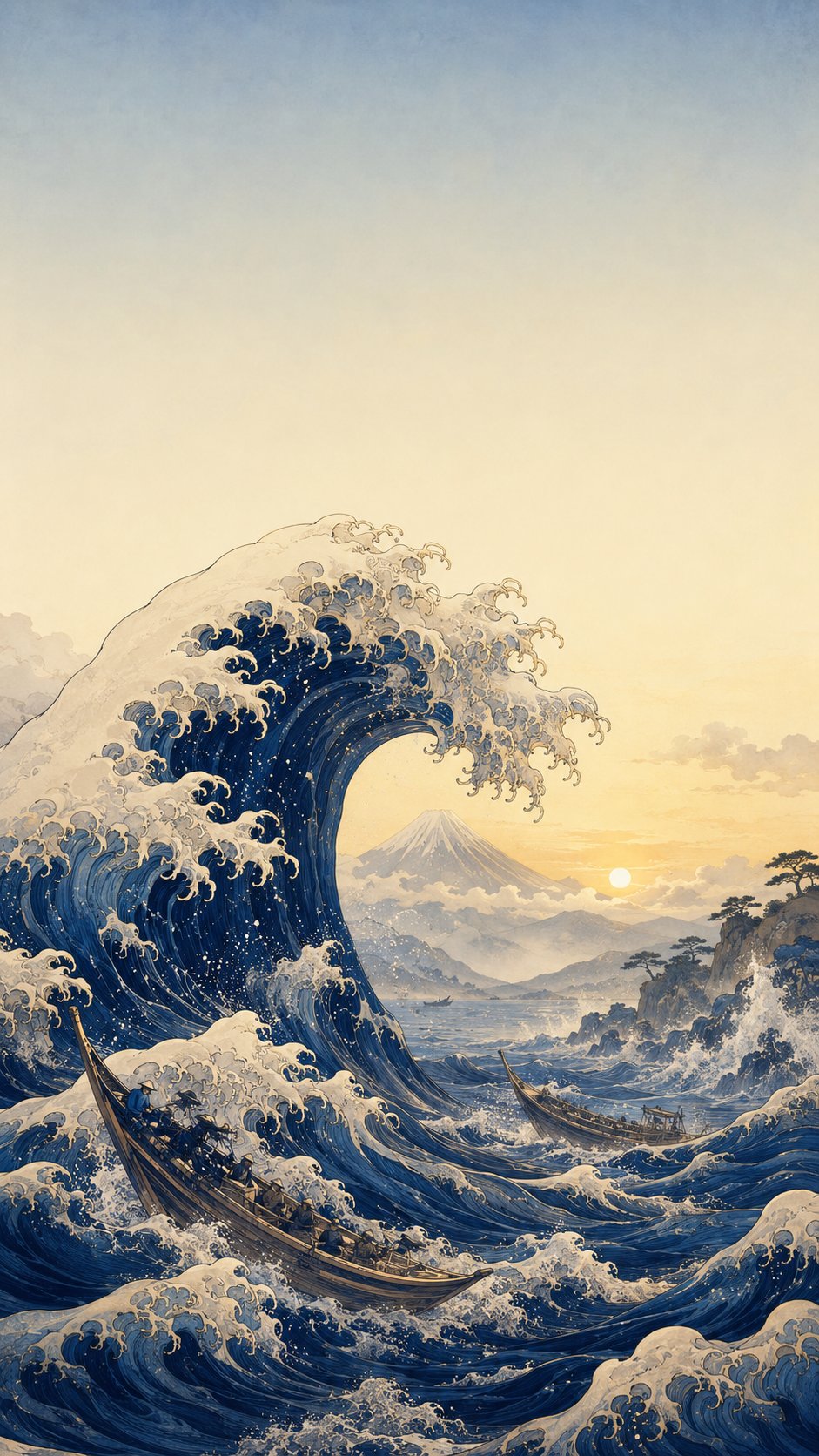
Hokusai — the artist behind the famous print of a curling blue wave — had already made it when he wrote that everything he produced before the age of seventy was not worth taking into account, and that by a hundred and ten every dot he made would be alive.

The passage comes from a postscript he wrote at about seventy-five. He describes drawing obsessively from the age of six, dismisses his entire earlier output, notes that at seventy-three he had begun to grasp the real structure of animals, plants and birds, and projects forward: at eighty he would make more progress, at ninety penetrate the mystery of things, at a hundred reach something marvellous. He signed some late work 'the old man mad about drawing', and kept working until he died at eighty-eight.

Q1637
StillnessArt

Wabi-sabi is the sense of beauty in things that are imperfect, impermanent and incomplete — a cracked bowl, a weathered post, a garden left slightly wild. It is beauty that admits time exists.

The two words started apart: wabi meant the loneliness of living simply, sabi the quiet that comes with age and wear. Joined, they name an aesthetic that runs through the tea ceremony, ceramics and garden design — rough textures, asymmetry, muted colour, and objects that show their history rather than hide it. It is a deliberate counterweight to the idea that beauty means flawless and new. The related craft of kintsugi takes it literally, mending broken pottery with gold so the repair becomes the most beautiful part.

Q1638
StillnessArt

'Ma' is the Japanese idea that the gap — the pause in music, the bare wall, the silence between words — is not absence waiting to be filled. It is an active part of the composition.

The character combines a gate with the sun showing through it: light in an opening. In architecture ma is the interval between columns, in music the rest between notes, in conversation the pause that carries the meaning. Western design tends to treat empty space as leftover; ma treats it as the element that gives everything else its weight. It shapes ink painting, garden design, noh theatre and modern Japanese graphic design — and it is why a nearly empty page can feel considered rather than unfinished.

Q1642
StillnessLanguage

Saudade is the presence of an absence — longing for a person, a place or a time that may be gone, far away, or may never have existed at all. Portuguese speakers treat it as untranslatable, and they are close to right.

It is not quite nostalgia, which looks backwards, nor melancholy, which has no object. Saudade points at something specific and holds the ache and the sweetness together — the pleasure of remembering is part of the feeling, not a consolation for it. The word is bound up with Portugal's centuries of sea voyages and the people left waiting on shore, and it is the emotional engine of fado music. Brazil marks a Day of Saudade on 30 January.

Q1643
StillnessLanguage

Mono no aware names the gentle ache you feel at something beautiful precisely because it will not last — cherry blossom, a child's age, a good evening ending. Not grief. Awareness.

Literally 'the pathos of things'. The scholar Motoori Norinaga made it central to Japanese literary criticism in the eighteenth century, arguing it was the true subject of The Tale of Genji — not morality, but sensitivity to transience. It explains why the cherry blossom, which lasts about a week, is the national flower rather than something hardier: the brevity is the point. The feeling is not sad exactly. It is what happens when you notice that a moment is already passing while you are still inside it.

Next reading modeWonderIdeas for closer looking.