Ideas for living

Philosophy

Arguments, teachings and durable questions about attention, conduct and a meaningful life.

350 entriesPage 14 of 15Context and sources

In this room

Follow the subject sideways.

Cards are connected by subject and by mood. Move through the complete sequence below, or cross into a neighbouring part of the archive.

170Drive
169Stillness
52Wonder
Q1263
DrivePhilosophy

The measure of who we are is what we do with what we have.

Often attributed to the legendary American football coach Vince Lombardi in coaching and leadership circles, though the exact wording has not been traced to him. The idea is older than any coach: character is measured at the intersection of means and choices — not what you were given, but what you built with it.

Q1264
StillnessPhilosophy

No one saves us but ourselves. No one can and no one may. We ourselves must walk the path.

A widely quoted English rendering of a theme from the Dhammapada (verse 165 is the closest anchor: “By oneself is evil done… by oneself is one purified”). Its point is not loneliness but responsibility: in the Buddhist picture, teachers point the way — the Buddha called himself only a guide — yet the walking cannot be delegated.
Q1425
StillnessPhilosophy

Care ethics brings moral attention to dependence, illness, childhood, ageing and the quiet labour that keeps lives possible.

Care ethics does not begin with the fantasy of a perfectly independent person. It begins with the child, the patient, the ageing parent, the exhausted friend, the person who cooks, listens, cleans, remembers and returns. It adds a sharper question to moral life: whose vulnerability is being protected, and whose work has been made invisible?

Q1486
StillnessArt

Tibetan Buddhist monks build intricate sand mandalas grain by grain over days or weeks, then ceremonially sweep them away, pouring the sand into flowing water.

The destruction is not an accident or a loss but the point: the work is a meditation on impermanence, and letting it go is part of the art. Nothing about the beauty was wasted; it was simply never meant to be kept. In a culture that measures art by what survives, it is a quiet, radical idea — that a thing can matter fully and still be released.

Q1494
DrivePhilosophy

What is now proved was once only imagined.

This line comes from the 'Proverbs of Hell' in William Blake's The Marriage of Heaven and Hell. Blake — poet, painter and engraver — trusted imagination as a form of knowledge, not its opposite. Every proven fact, every built bridge and tested theory, began as something someone first pictured in the mind.

Q1496
StillnessProverbs

After rain comes sunshine.

'Efter regn kommer solskin' is a common Danish saying. Like many weather proverbs from northern Europe, it turns an ordinary fact of the sky into a quiet promise: hard spells are weather, not climate — they move through and pass.

Q1498
DriveProverbs

Who risks nothing gains nothing.

The Portuguese say 'Quem não arrisca, não petisca' — literally, who doesn't risk doesn't get a bite to eat. The rhyme makes it playful, but the point is old and plain: nothing worth having arrives without some exposure to loss.

Q1499
StillnessProverbs

What's meant for you won't pass you by.

In broad Scots, 'Whit's fur ye'll no go by ye.' It is a saying of trust rather than fatalism: you can loosen your grip on what you cannot control, because whatever is truly yours will find its way to you in time.

Q1502
DriveProverbs

Little by little, the bird builds its nest.

'Petit à petit, l'oiseau fait son nid.' A bird brings one twig at a time, and a home appears. The proverb is France's gentle case for small, patient effort: large things are made of many small acts that do not look like much on their own.

Q1503
StillnessProverbs

There is no bad from which some good does not come.

'No hay mal que por bien no venga.' Spanish speakers reach for this when a setback lands: not a claim that everything is fine, but a reminder to stay open — misfortune often carries, folded inside it, a door you could not have seen from the other side.

Q1505
StillnessProverbs

This too shall pass.

The saying is often traced to Persian Sufi poetry, where a king asks for words that would be true in every season and is given a ring engraved 'این نیز بگذرد' — in niz bogzarad, 'this too shall pass.' It steadies joy and grief alike: neither is the final word.

Q1631
DriveLanguage

The Japanese word joins iki — life — with kai — worth. It names whatever makes your days feel worth living, and in Japan that is usually something small and ordinary: a garden, a grandchild, the walk to the shop.

The psychiatrist Mieko Kamiya gave the word its serious treatment in her 1966 book On the Meaning of Life, written after years working with patients at a sanatorium. For her ikigai was not a plan or a purpose to be solved, but the quiet sense that your days point somewhere worth waking for — and she found it in people whose circumstances were desperately hard. If you have ever come across a four-circle diagram promising to locate your ikigai where passion, skill, money and the world's needs overlap, that is a separate idea: it was drawn by a British blogger in 2014, adapting an earlier diagram about finding your purpose. The Japanese original asks far less of you, and gives more back.

Q1635
DriveArt

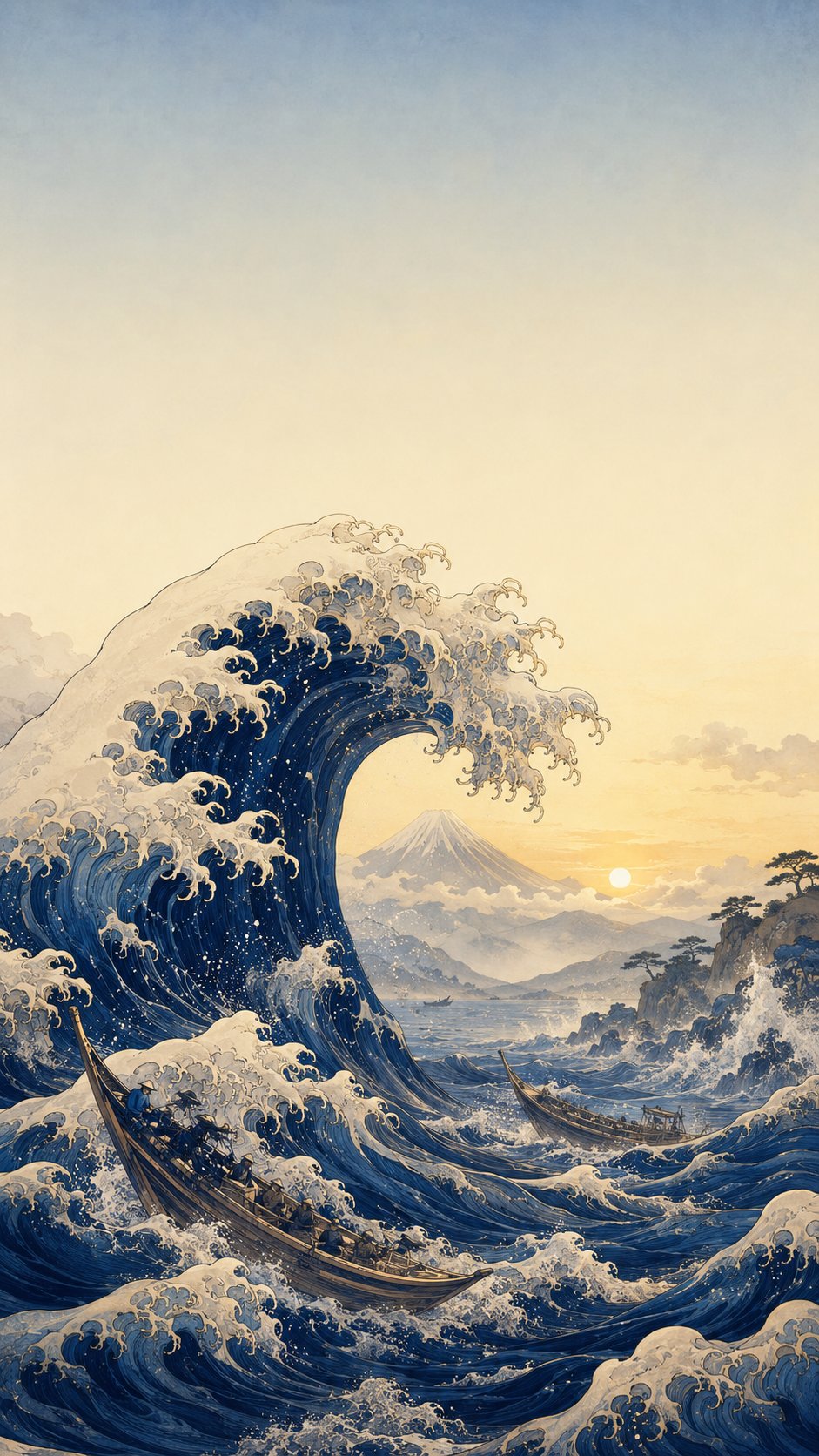
Hokusai — the artist behind the famous print of a curling blue wave — had already made it when he wrote that everything he produced before the age of seventy was not worth taking into account, and that by a hundred and ten every dot he made would be alive.

The passage comes from a postscript he wrote at about seventy-five. He describes drawing obsessively from the age of six, dismisses his entire earlier output, notes that at seventy-three he had begun to grasp the real structure of animals, plants and birds, and projects forward: at eighty he would make more progress, at ninety penetrate the mystery of things, at a hundred reach something marvellous. He signed some late work 'the old man mad about drawing', and kept working until he died at eighty-eight.

Q1637
StillnessArt

Wabi-sabi is the sense of beauty in things that are imperfect, impermanent and incomplete — a cracked bowl, a weathered post, a garden left slightly wild. It is beauty that admits time exists.

The two words started apart: wabi meant the loneliness of living simply, sabi the quiet that comes with age and wear. Joined, they name an aesthetic that runs through the tea ceremony, ceramics and garden design — rough textures, asymmetry, muted colour, and objects that show their history rather than hide it. It is a deliberate counterweight to the idea that beauty means flawless and new. The related craft of kintsugi takes it literally, mending broken pottery with gold so the repair becomes the most beautiful part.

Q1638
StillnessArt

'Ma' is the Japanese idea that the gap — the pause in music, the bare wall, the silence between words — is not absence waiting to be filled. It is an active part of the composition.

The character combines a gate with the sun showing through it: light in an opening. In architecture ma is the interval between columns, in music the rest between notes, in conversation the pause that carries the meaning. Western design tends to treat empty space as leftover; ma treats it as the element that gives everything else its weight. It shapes ink painting, garden design, noh theatre and modern Japanese graphic design — and it is why a nearly empty page can feel considered rather than unfinished.